Saturday, 29 June 2013

#artmooc week 5: Inside the space: installation art

The task this week was to get out of the room, house, flat, cottage - and make an installation that interacted or communicated with the space in which we wanted to set it. Our instructions were:
This week’s content is quite different from the movements and styles that were addressed in the previous weeks. This week you will be working three-dimensionally and engaging space. Creating a site-specific environmental installation is a very unique experience (especially if you have never attempted it before). Your goal will be to find a meaningful outdoor site and produce an installation specifically for that area. Considering the site and its relationship to your installation will be one of your most important objectives.
# 10: Get out of that classroom - and really see your space
It has been a wonderful challenge - and a completely different way of enjoying a walk in the countryside... Though it could have been just as exciting to create an installation in an urban landscape. This week's lesson for practice would definitely be to get students out of the classroom - and into the spaces outside. I would set them the task of creating mini-installations - and reflecting on them the way we have been asked to reflect on ours. Here are some pictures of my installation - and my answers to those contextualising, reflective, creative questions.


1.  Explain your process (medium and technique).  How was it made?  Which art materials and approaches did you use and why?
This assignment was all about the process for me – the process of truly inhabiting the landscape near where I now live – and playing with it – photographing it – making small installations here and there – and of eventually choosing the installation that I liked the best.
I spent three hours slowly walking around the area – up hills, down tree-shaded paths, near large fields, beside trickling springs… I wound wool-like rope into trees, I placed my shoes in puddles, I placed shoes walking in to and out of various forms of greenery… I floated my shoes in water, I created caches of stones and leaves in bole holes in trees, I shaped wheat from broken wheat stems, I photographed a knotty root as if it were itself a tree – and added a twig with leaves… but in the end the installation that I loved the most was installing a strip of blue-plastic-covered wiring into the most beautiful bush/tree – where it complemented the green of the leaves, the white of the flowers and the yellow of the lichen. It was a false damsel fly in a verdant bush – and I loved it.
The point of this installation is the close up – and it is very much captured in the very first photograph – but I have uploaded a picture of me making the installation as the ‘long shot’ to give a sense of scale and place. 
2.  Describe the idea behind your artwork.  What story or message does it get across?  What does it mean to you?
This installation was about looking really closely and intensely at a very small piece of the countryside – and seeing the wealth of detail, colour, intrigue and beauty in that small piece. Juxtaposing a false damsel fly was designed to catch and draw the eye – to draw attention to the place that held the 'damsel fly'. The colours were held in harmony – the shapes also complement and frame each other. This was a small but perfect installation. The message was that the very small can be as breathtaking and beautiful as the very large.
3.  Why did you create it?  What are your reasons for creating that specific art piece?  What do you want your audience to feel and think while observing it?  
I wanted to capture something intensely beautiful – but small – and that epitomised where I now live. I moved to the countryside from London, England. When in my twenties I could never ever imagine NOT LIVING IN LONDON. It was everything to me – pulsing with energy and life and happening… It was impossible to not live in London. As Samuel Johnson (I think) said: ‘He who tires of London tires of life.’ I absolutely believed that… Now – I see the life and beauty of the countryside – not just in the breadth and depth and height of it – but in the very small spaces as well. I have changed. This installation reflects that the wonder and beauty of everything can be in that very small thing – if we take the time to pause, to look and to see. I hope this is a beautiful Zen moment for the onlooker.

Thursday, 20 June 2013

#artmooc week four: through the lens… lessons for practice

This week was interesting on many levels: content, task, student reactions. The course covered portraiture from Egyptian statuary to the feminist photo-portraits of Cindy Sherman. We explored the differing relationships between the portrait and society; and between artist – model - society.  Early portraits demonstrate power and status, caricatures became political commentary and documentary style photography was used in the early 19th century to educate the workers about the new technology of the industrial revolution. Dorothea Lange documented the Depression and the Second World War in America – with specific reference to the impact on the lives of ordinary people.  This sort of documentary work was not just to record inequality in society – it was designed to change society.
This week’s task was to take a black and white photograph of a chosen subject – and then to render that as a collage portrait using newspaper pieces. The intention was to get us to explore texture and tone in a very slow, intense and embodied way; and to use those to portray the essence of our subject to the audience.
Here are some of my pictures – with a brief discussion of what I was trying to achieve – followed by potential lessons for practice.


 Wild one:
I developed a collage portrait of a youth in a leather jacket standing in a still wild space in urban London.... This was the 1980s and had exactly the feeling that I wanted to explore - human 'wildness' in an urban setting. After sketching the face onto a larger sheet of paper – using a pencil to indicate tone – I started to build up the portrait.
When making the collage
I sat down with the photo in front of me - and the sketch on the floor and a large pile of Observer newspapers. I started to tear off dark strips to capture the darkest parts of the picture - and also to set a shape to the face. As I started to fill in the outline and formalise a shape, I started to use elements of more organic pictures - earth, rocks, trees, elephant skin, sky, clouds, fur - to detail the face and create the wild feeling that I was after. I don’t think that I obeyed the ‘rules’ of the task – but I am really pleased with the final portrait and the effect is achieves.
General lessons: As always - the most basic lesson for practice is to recreate this activity as a multi-modal experience - requiring students to slowly create meaningful images... Or you can set students the task of documentary photography - either to teach a topic themselves in a photo-essay or to record a particular phenomenological situation. If your students are making their own digital artefacts, the whole lesson that we covered would be useful. You could set the students the task of exploring the development of the portrait from the Egyptians through the imagery of the middle ages and the renaissance to Cindy Sherman - and to convey what they had learned visually. They would learn much that would develop their ability to tell stories in ways that put them in control of their own imagery. Here are a couple of other things I discovered:
#8 There will be dissent… but *still* the best student is not the most obedient
No matter how interesting or meaningful or challenging the assignment - there will be dissent. When you have set a good task with excellent learning outcomes, stick with it – do not be ‘bullied’ by negative student voices… At the same time – the best students are not necessarily the most obedient ones. It can be the most engaged who are often the ones who push and pull at the boundaries – who challenge the rules and constraints. It is our art to know the difference. 
#9 It is worth investing time in slow, embodied learning
So many students in the MOOC complained about this week’s task… and yes, it was a slow and painful process to put the portrait together. It would have been much easier to create tone and texture with a pencil… But this difficult and ungainly task allowed difference and otherness to emerge – and built a different relationship to tone and texture. In this byte-sized 24/7 world it is still important to create these slow learning moments. One way to recreate this in your subject might be to get your students to create 3D models of the concepts and theories you are exploring…


Friday, 14 June 2013

#artmooc week 3 Correspondence with memory – suggestions for practice

This week we studied ‘Mail Art’ or Correspondence with Memory – and connected with Fluxus Art of the sixties. There are elements of the personal and the surreal in this movement – from Van Gogh’s illustrated letters to his brother to Eleanor Antin and her series of 100-boot postcards capturing images of 100 boots as they journeyed from the Pacific to New York – and Ray Johnson’s provocative abstracts and collages – connected by cartoon-like bunny faces that then became a signature.

Our task was to create a memory of our own and capture it upon an envelope – front, back, sides and inside. This was to be extended by the insert(s) that we made and placed within the envelope; designed to intrigue the audience.

I chose to illustrate memories of Leysdown – a seaside town where we had a caravan by the sea. We used to go there from when I was about eight – and it was freedom.

I used a variety of media to make this artefact:
  • Medium quality deckle paper for the envelope
  • A4 paper for the insert
  • Watercolours – for envelope and the ‘swimming’ shoes part of the insert
  • Pencil and small brushes
  • Small colour prints of Leysdown - pictures downloaded from the internet – cut to look like miniature postcards and photographs
  • Shells and stones gathered from Leysdown itself
  • Tissue paper sea and shore
  • Small boat – in blue and white. 
I chose a square envelope shape so that it looked like an explosion of images and ideas when it burst open. I painted the front of the envelope to look like a postcard from the seaside. It is a Surreal representation (after Miro) of my niece sunbathing in black outside the caravan, by the sea. I chose Surreal to juxtapose the ordinary with the extraordinary – and thus illustrate the potentiality of the seaside. The external side flaps are drawn and painted with images of pill boxes – a common sight in and around Leysdown – from the war – but I’ve turned them into representations of the face of Ray Johnson’s rabbit – a nod to Mail art and its history and connecting it to Leysdown and its history. The top and bottom flaps show the flat sea and the sea forts (more memories of the War) in the distance – with seagulls. The images mirror each other: the top is more grey showing the more regular reality of the North Sea – cold and desolate – but the bottom image has more yellow and a lighter blue, it is slightly sunnier than the top. I’ve painted very sparsely, a few black lines of paint on white, on the inside of the envelope to create a simple, calm Buddha like face – representing my inner calm and peace when I go to Leysdown. The insert is a cut out of a ‘blind drawing’ of a pair of the ‘swimming’ shoes that I use, there are sharp cockles (shell fish) in the silt-like mud under your feet – I always try to swim there and it is so much easier when your feet are not bleeding. I also included many small pictures of the flat and desolate coast itself - and the shoes and the images are designed to fall out of the exploded envelope amongst small rocks and shells from Leysdown itself. I have placed this on layers of tissue paper – sheets of different blues and green mirroring the complexity of the seascape – and a layer of yellow for the shore. I added a small boat in blue and white to tie the whole together.

Here are a few pictures of all of the outside of the envelope – and the inserts – and the setting that I placed them in:


Possibilities for practice:  of course one possibility is just to do this Mail Art with your students as an alternative form of reflection – and perhaps as a precursor to writing. Other lessons: don’t wait for inspiration - because assessment can wound… and peer review is excellent. Let me unpack that a bit:

#5: Assessment can wound!
So – received my peer assessment and my grade – which incidentally was MUCH WORSE than the grade that my YOUNGER SISTER received! (And yes I do know that I am shouting.)

Three people reviewed my collage and none of them actually liked it. Nearly all of them gave me friendly and encouraging comments – but my grade was just a little over the average. Now I am not young and I’ve been knocking about Education for some very long while so I did not take to my bed and weep, but … Feedback can be dispiriting no matter *how* helpful. I wanted to discuss those comments with my assessors – and put my case – and change their minds… and yes I felt a lot less enthusiastic about this week’s task than I did before.  What can we do about this? We do mark and grade and we do give feedback and feed forward and we hope that it helps. Perhaps we need to actively develop resilience (not Gove’s form of resilience!) in our students so that they do not bend and break under our feedback? Perhaps we need to make more time to give feedback in person and in conversation – and wouldn’t it be great if that time was valued by our institutions.

#6: Let’s build in more work – and lots of peer review
MOOCs set a lot of work each week (and still we usually do *more*) – and peer review is considered to be part of the learning and part of the assessment process. I do know of postgraduate courses that set peer review, but everyone tells me that undergraduate students won’t do it. However, I hope that if we start in the first year and from the first week to set rigorous weekly tasks that are peer-reviewed as the norm, no one will even think to object. 

** If you have any suggestions and strategies for developing peer review in undergraduate courses – please do let me know. ***

#7: Don’t wait to be inspired – just do it!
As said, my feedback dispirited me somewhat, and I started to feel under-whelmed by this week’s task. However, I have studied often before – and I wanted to get the assignment done… so I just did it anyway. I always advise students not to wait for inspiration: have a set time and place to work – and just do it. Just start; just brainstorm; free write; put BLAH BLAH BLAH and move on … but get something down and you are on your way. I did exactly that for this task – and it is done.

Of course when working with ‘non-traditional’ students, we may need to help them build this work habit rather than just expect it to emerge. Hence the suggestion above that in at least one first year module we do set weekly, rigorous and hard tasks for them to do – and to peer assess as part of their learning process. If we help to build positive habits they too will be sustained when tired or uninspired or lovelorn or any of the things that get in the way of work.

NEXT WEEK – portrait with collage – ooo errrr.


Saturday, 8 June 2013

#artmooc week 2: Fantastic Art... and the classroom

This week we explored Fantastic Art – Bosch, Rousseau, Chagall, Chirico, Man Ray, Duchamp, Arp, Ernst, Miro and Dali. After reading about them and observing videos upon them (this is more of an xMOOC (content-driven) than a cMOOC (connectivist)), we had to choose a topic and an influence and produce an art work of our own. We had to justify our process and our product – and the intended impact upon our audience. I chose to produce a collage – channelling the unconscious to see what would appear. Here's my picture-making - and then some thoughts on how we might use this in teaching. 

My picture-making process:
My approach was to weave the Surreal and the DaDa together – to explore a deep emotion through chance and a lack of control – to create a picture with rhythm perhaps – but not in a controlled way.

I drew on the Surreal because I wanted to channel the unconscious – I wanted to see what would emerge when I explored a deep emotion, when I let my unconscious out.

I chimed with DaDa because of the destructiveness and chaos of their art; their reaction to the World War. There could be no beauty in a time of such horror – no controlled and controlling art to soothe the senses - for this would be a lie. Their anti-art was designed to confound and challenge the immensity of total war. I wanted to explore the immensity of betrayal; when it happens this is a personal atrocity. I was heavily influenced by Miro and the automatic – the sense of bringing forth deep emotion to see how it would look when it revealed itself. I wanted to harness something like Arp’s approach to collage – that if you do not control the process too much, the picture will reveal itself. Like Duchamp, I wanted to ‘find’ the picture in the newspapers that I chose randomly – and the random words and pictures that I cut out. And like the Hannah Hoch example we saw, I was using dull newspaper and newsprint, not the shiny glamorous material that is the magazine picture. This was partly because the newspaper was to hand – and mostly to reject the shiny shiny happy of magazine paper.

The pictures below show final draft - first draft - sketching the first draft - building on to plywood - adding paint details... 


 How we might use in practice:

# 3: We can model reflection to develop voice and power
How many times have you seen a reflective assignment – and how many times do you see students not energised but deadened by the process? With our task – we had to reflect on what we had learned – apply that to a new challenge – and then we had to discuss what we had done and why. This seems a more challenging way to tackle reflection. Specifically we had to consider:

1.  Explain your process (medium and technique).  How was it made?  Which art materials and approaches did you use and why?
2.  Describe the idea behind your artwork.  What story or message does it get across?  What does it mean to you?
3.  Why did you create it?  What are your reasons for creating that specific art piece?  What do you want your audience to feel and think while observing it?


Even as I copy and paste these instructions here, I think you can see how applicable they can be to an academic context. How different these words are to the implicit instructions behind so many of our assignments: shut up, I’m not interested in what you have to say or in what you think and feel. I want to know whether you have understood the importance of what I have told you – and whether you can cough it back up to me in a way that shows me you are a good and proper student.

I love that these #artmooc instructions assume that the student has something to say – and that they can engage with theoretical ideas and concepts – and be trusted to bring all this together in a meaningful task. I definitely want to use instructions like these in my teaching in future – something like:

‘Okay – we’ve looked at [insert ideas theories or concepts relevant to your subject] – now design an art work or teaching/learning resource to bring one or all of these concepts alive to another group of people:

1.  Explain your art or teaching/learning process.  How was the resource made?  Which activities, materials and approaches did you use and why?
2.  Describe the idea behind your resource.  What story or message does it get across?  What does it mean to you?
3.  Why did you create it?  What are your reasons for creating that specific resource?  What do you want your audience to feel and think while observing it or engaging with it?’

Here the student is both in the task and over the task – their voice is heard – not in empty reflective gestures – but in a way that invites them to powerfully engage.

If not art – think poetry and prose
In a recent Jiscmail exchange (www.jiscmail.ac.uk/ldhen) I was talking about an early exercise I used to do with students to introduce them to academia – its processes, practices and genres. Each week we would read and analyse poetry and prose – interesting and engaging poetry and prose (!) – and then I would ask them to write about something that they wanted to write about – using the genre or style that we had just explored. At the end of the course, I collected and published their work.

We modelled good academic practice as we discussed, criticised and argued our case - and each time they wrote they mastered a new genre – as later they would have to master the essay, report and presentation. But most importantly, they were interested and engaged – and when they wrote, I respected that they would have something of value to say. 


#4: Use collage
I found the production of my own collage intensely absorbing – it was hard work – but oh was I engaged with it. When I wrote the reflection I managed to tease out many more ideas – and to craft an argument together about what I had done and why. More reflection on the piece that I had produced, generated further insights… and this really was writing to learn. I am looking forward to bringing collage into my practice. A colleague and friend, Pauline Ridley, recommends the use of collage to get students more engaged with potential dissertations and projects – see her website for many ways to get the visual into teaching and learning: http://www.brighton.ac.uk/visuallearning/.

With project planning, she suggests that we get resources and students together – and invite them to channel their feelings about a course as they create their collages. Once they have produced the collage – they can step back and analyse it – and choose an engaging topic to explore – instead of researching something because it vaguely seems like a good idea.

I also want to use collage to give students more power and control over their learning. My plan is to insert a collage day about week six of a long course. At the beginning of the course I will herald this as a day of fun and excitement – and ask students to prepare for it by cutting words and pictures out of newspapers and magazines. On the day itself, I might divide the class in two – one half to use the words and pictures to reflect back on the learning that has already occurred – to summarise this highlighting the ideas, theories and concepts of most interest and significance to them. The other half could be invited to refer to their Handbooks and speculate on the learning to come – or to think about the learning that had occurred and how it can be used in the assignment. 

I am exploring here – so this will evolve before the session itself... Meanwhile some resources and tips for those who want to try this for themselves.


Collage resources
White glue & glue spreaders
Words and pictures cut from newspapers and magazines
Scissors
Card or large paper
Possibly acrylic paint or ink to add detail
Paint brushes – large, small and minuscule
Rollers
Cloths

Approaches
My approach was to weave the Surreal and the Da Da together – to explore an idea through chance and a lack of control – to create a picture with rhythm perhaps – but not in a controlled way.

I would suggest that you introduce notions of the Surreal – allow students to see what emerges when conscious control is let go. Show some images from Chagall, Arps, Duchamp and Miro to loosen them up. Students may not be aware of all they are engaging with and learning and the complexity of the whole University experience; Surreal collage allows some of this out for further consideration.

Possibly introduce elements of DaDa. Dadaism was a reaction to the destructiveness of World War. There could be no beauty in a time of such horror – no controlled and controlling art to soothe the senses Their anti-art was designed to confound and challenge the immensity of total war. Students may be reacting against academia and its control – and may need to explore that.

Random poetry generator
On the way to making my collage I became fascinated by the words that I cut out from the newspaper and put them in a clear plastic folder to see what you could read from them when they moved about kaleidoscopically within the bag. You could get your students to do the same to see how this sparks thoughts about the course and their learning to harness when producing their collages.

Tips
I did not over-think the laying out of the pieces – I sat down and very quickly chose pictures from my collection of small to medium pictures and lay them together, initially on a towel on the floor. I moved them till they looked good. I picked small pictures that I liked and placed them …

When the first rush was over – I saw that I needed some framing pieces. I got my large pictures and squeezed some under the top of the picture; some I cut up and used to frame the bottom.

I sketched this rough draft to get a sense of the overall shape and placing of pictures – but I was not going to stick to it rigidly – if different placings emerged as I made the next draft – then that would be okay.

I then started trimming the newspaper pictures and placing them on plywood (I did not have paper or card large enough) …spreading the glue and placing the pictures – sometimes rolling them flat – sometimes padding them flat.

Encourage this process in your students – allow it to be fun. Encourage them to be absorbed and work in silence if that suits them - or encourage them to explain what they were doing, the pictures they had chosen and why… as they are gluing the final pieces down.

When the students have finished producing their collages, they can present them to the class – using the reflective questions if you wish:
Describe the idea behind your artwork.  What story or message does it get across?  What does it mean to you?

Why did you create it?  What are your reasons for creating that specific art piece?  What do you want your audience to feel and think while observing it?

But notice
What might have happened as they produced their works, is that conversations about the course were taking place. The collaborative process here provides an hermeneutic or reflective space in which learning can happen – within themselves and between each other. At the end of the session not only have you modelled interactive and connectivist and collaborative learning – and good notemaking – and positive reflection … you should have some wonderful pictures to put up – or to photograph and place in your VLE – and your students should have a new energy and enthusiasm about each other – and about the course itself.

Your turn...


Thursday, 30 May 2013

#Artmooc: Introduction to art: concepts and techniques


So despite all sensible thoughts to the contrary (too busy, too exhausted, too stretched, too near my physical limits, too old…), I’ve signed up for another MOOC. This time I’m on Coursera’s ‘Introduction to art: concepts and techniques’  and I will be following the practical, Studio, route through. This means that as well as studying art, artists and art movements, I will also be attempting at least one art assignment per week – and engaging in peer review of other pieces.

You can find out more here: https://class.coursera.org/art-001/class/index 

I am doing this for fun – but I am also looking for creative ways to improve teaching, learning and assessment at my University.


Lesson #1: The role of the social in studying
My first MOOC was also from Coursera: Edinburgh University’s 'E-learning and Digital Cultures', a brilliant six-week course, tagged and tweeted as #edcmooc.

As a student of that course I was really lucky that a friend got ‘in there’ before me and invited me into the Google+ groups that were attached to it (one with thousands of people – one with just 16 members) and also into the FaceBook group. This meant that I very quickly found the size and shape of the social space that I needed to help me feel like I belonged  - and that ‘held’ me in that course.

Fraingers (virtual friends and strangers) from the smaller Google+ group have already written on the experience of collaborating in informal spaces – and of how this helps to tame the otherwise potentially overwhelming experience of a MOOC:


It is ironic that this very human lesson occurred in virtual or cyberspace – and I’d argue that this is a lesson that we need to bring very quickly back to our physical, human teaching and learning spaces.

Humanising the education marketplace
If we want to keep and nurture our students – especially our non-traditional students – we need to re-humanise higher education. Our students are experiencing rapid educational change; for them university is highly marketised and impersonal: not so much a stroll across the quad – but a sense of pile ‘em high and teach ‘em cheap. Not hallowed halls, but commodified courses sold like toothpaste. So we should not be surprised when students notice and internalize this - or get switched off and drop out! But if we want to do something about it , we need to help students to find friends on and off their courses – get them actually into those Clubs and Societies - hook them up with Peer Mentors – make it human and they will feel humanized and they will stay and blossom.

Lesson #2: Assignments can be fun
So as said, I was wobbling as to whether I could stay on this MOOC when SO BUSY… so I checked out the assignments for the course to see if they'd be so awful I could legitimately sigh and go. They looked brilliant. I wanted to do each and every one of them. So here’s another lesson for us in HE who teach anything but art: assignments CAN BE FUN. Yes, we are serious academics, intellectual gatekeepers of the academy; maintaining high standards and blah blah blah… But that does not mean that we have to set tasks that are boring, dull, re-gurgitative – we can challenge and extend our students.

I have written about this in posts below – most recently reflecting on a 'Becoming an educationalist' module that was paired with a second year 'Peer Mentoring in Practice' module. Here both sets of students were taught a creative curriculum – and the first year students were also set primary research as one of their assignments. With our modules, we regularly set the design and making of teaching and learning resources or digital artefacts as assessment alternatives to the academic essay…

This #artmooc is setting some wonderful assignments that will oh so easily translate into activities to enrich any module.

The assignments
So this week we looked at line, shape, value, texture, colour and collage and for our first assignment we had to construct and post a self-portrait that captured the essence of who and what we were. We had to post an image of our picture in an online Forum, with a brief  account of the what, why and how of it. We will move on to explore fantasy and the bizarre; correspondence, memory and mail art; photography, portraiture and collage; installation, space and the artwork; the world of wonder and cabinets of curiosities. I can see each of these as art – but also as reflective learning and multi-modal communications… I cannot wait to embed them in next year’s practice.

Here’s my effort:


This is a drawing of me, on the left, and my colleagues Chris O’Reilly and Tom Burns with whom I am doing a lot of work at the moment – especially with digital artefacts. I have done this as a ‘blind drawing’ and watercolour. Blind drawing is where you look at what you are drawing – but not at the picture developing on the paper – and you try to keep your pen on the paper as well. What I like about blind drawing is that it cannot be a realistic representation of the object that you are drawing. You are released from accuracy and into exploration. You never know what the piece is going to look like… You may not even like the picture that emerges – at first. So I find that blind drawing becomes a lesson in patience and joy.


This picture is deliberately not on good quality paper: there is nothing arty or iconic about it. I produced it to illustrate a conference presentation. I wanted to capture the sense of a moment, snatched and dashed down; a contingent, passing and ephemeral moment. I wanted it to be our Team – but also to illustrate that anyone can draw something. I love the freedom of blind drawing - and the child-like quality of 'colouring in' the drawing once I have done it. When I do this I am that child again, totally absorbed, lost in the moment of fierce and purposeful play. I am definitely hoping for more of this fierce play through this course.


Thursday, 23 May 2013

Writing Development - New Media - Digital Artefacts - Trialling Vocaroo

Today I am attempting to produce an audio blog.
I have talked about writing development and the use of new media.
I have recorded this using the open source recording facility: Vocaroo.
The eight minute recording can be accessed here (I hope!):

http://s1.vocaroo.com/media/download_temp/Vocaroo_s1fpjASJDCp7.mp3

The recording covers:

My job and tile:
I used to be the Coordinator for Development - but on the deletion of our Learning Development Unit, I was absorbed in to the Centre for the Enhancement of Learning and Teaching (CELT). I have a brief to work with staff and students: improving the chances of student success at University - and working with staff to embed good practice within the curriculum.

Where writing happens at University:
Writing happens everywhere at the University - learning/writing/academic development is embedded in and across the curriculum. At the same time, we in CELT offer:
  • Preparation for HE programme: We run a pre-sessional: where students rehearse notemaking, reading, presentations, positive thinking - and academic writing. with the writing, we explore attitudes to writing - and engage in writing. I like to demonstrate that writing happens when we make it happen (and writing as a learning process)
  • The Study Hub. We have built a supportive website for students...
  • 'Studying at University', on the Hub, has information on studying and writing - with video clips, information, activities - and the recommendation that students tweet, FB or blog about their learning experiences.
  • Writing Clinics: whilst rejecting the medical model - we use this shorthand to offer one-to-one support for students. We offer feedback on their writing and push them to do better. Whilst resource intensive, such one-to-one work can be especially transformative.
  • Stuff support: We work with subject academics to embed good practice - and hopefully elements of our Study Hub - within their own teaching.
The use of new media
We do use new media to support the development of student writing - with many staff building in wikis and blogs as part of the student learning and engagement process. At least one member of staff has won a National Teaching Fellowship based upon the development and impact of his student blog writing practice.

Alternative assignments
At the same time, I think that we can use new media to develop alternative assignments for students. There will always be the settng of essays, reports and exams - but I am lobbying to get more staff setting the design and development of a teaching/learning resource or the production and critique of a digital artefact as the assignment.

To support this:
I can deliver Draw to Learn sessions with students - helping them conceptualise  and communicate ideas visually. I have also delivered Digital Artefacts workshops with colleagues Chris O'Reilly and Tom Burns - and students have produced some wonderful work from these. The next step is to run these workshops for staff such that they can have the confidence and joy of embedding alternative assessments.

#edcmooc
Alongside this - I would like to embed practice gained from the E-Learning and Digital Cultures MOOC (Massive Open Online Course) delivered through Coursera by Edinburgh University - where the assignment was to produce a Digital Artefact - and to peer review three other artefacts. That is, the peer review was seen as part of the learning process.  I would recommend a MOOC like this to anyone interested in exploring new media for teaching, learning and assessment: the best way to learn the digital is to do the digital.

What I forgot to say...
... in the audio-blog was that we have several other strategies in place for supporting the development of writing. We have also developed a Peer Mentoring in Practice accredited module where second year students support the transition of a specific cohort of first year students - and we support the Mentors in developing supportive writing strategies with their mentees.


We also run Writing Groups for staff and students creating a space in which writing can happen. My colleague John Hilsdon from Plymouth University and the Association for Learning Development in HE has run Virtual Writing retreats for academic writers. Other colleagues - Sally Mitchell, Julian Ingle and others from Queen Marys University of London - run Writing Retreats for students - including STEM students...
  And finally
It has been interesting using new media - especially Vocaroo - to produce this blog on using new media to support student writing. Be kind - it is frightening to cast my very first audio-blog out there into the ether. (That's a north London accept - by the way.). Finally, I am always interested in working with other people interested in developing these ideas - so do get in contact.

Friday, 12 April 2013

Discourse, Power and Resistance 2013


The friendly yet challenging and stimulating Education conference was at Greenwich again:

We were presenting in the Symposium strand: ‘Stimulating or stultifying? Teaching as if education matters’, organised by Eloise Sentito, from Plymouth University’s Learning Development Team.

There were three excellent Key Note speakers across the three days: Roger Slee, Diane Reay and Bev Skeggs. Roger Slee spoke on the myth of ‘inclusion’, creating a poetic tapestry of references to underscore his points. (Unfortunately I have already shared my notes on his session with colleagues who are interested in Special Needs education so I cannot make detailed reference to his talk here and now.)

Diane Reay, Cambridge University, and previously from my own Alma Mater, London Met, gave a sharp focused key note: ‘Outsiders on the inside: the continuing power of working class exclusion’.

Diane spoke of the current scholarisation of childhood – with a middle class agenda which confers and reaffirms privilege on that class whilst setting up a climate of pathology and blame around working class failure in education.  For the w/class, school offers a mirage of opportunity whilst constructing collective disappointment which is painful and shameful; constructing psychological and social damage. In this system the working class child is systematically and collectively constructed as worthless whilst being individually blamed and stigmatised for their poverty, financial and aspirational; their failure; and their silence. The new hidden curriculum of this age of ‘education’ is the inculcation and normalising of a neo-liberal agenda which for the working class becomes internalised as self-hatred and self blame. Reay argued that our political elites put a lot of class work in to their policies and in ensuring that the w/class are forever and always (blamed for being) educational losers.


Bev Skeggs’ fascinating and engaging key note reported on her ESCR project: ‘Making class and self through televised ethical scenarios’, which focused on constructions of the shameful (working class) self through reality television (RTV) (www.identities.org.uk).  This was a wonderful consideration of the intended class work of RTV – and a making conscious of the oppositional readings that we can make, aware as we are of the intended manipulation of this melodramatic form. Great points about the ‘moral economy of person production’, the ‘forensic gaze’ of RTV and, as with education, how the w/class are individually blamed and shamed – and invited to aspire to individual transformation at the hands of all powerful experts – whilst structural inequalities and symbolic violence is hidden, denied.


Seminars and workshops
Eloise Sentito: Leader of the Symposium Strand: ‘Stimulating or stultifying? Education as if learning matters’ – kicked off our Symposium strand…

You might notice that is a slightly different title to the one that I keep returning to – but I have left both in this post – cos they capture some healthy tensions in our strand: In terms of a stultifying education, how far is the teacher the issue? How important is teaching? What is the role of learning? What ‘work’ is being done by the new learner-centred rubric?

Eloise’s workshop was entitled:
‘Vortex street dynamics in teaching and learning: conceptualising intellectual relationships’

Eloise opened with: ‘there is stultification whenever one intelligence is subordinated to another… whoever teaches without emancipating stultifies’ (Jacques Ranciere: The Ignorant Schoolmaster pp13, 18)… and went on to consider the different intellectual models offered by Socrates; Giroux, Rousseau and Dewey; Freire; Ranciere; Learning Development; Peer Assisted Learning. Eloise illustrated these models with drawings of different circles, spirals and vortices – and we were invited to produce visual or three-dimensional models for ourselves. Discussing our different illustrations allowed us to make conscious implicit attitudes to teaching and learning to stimulate further discussion on what teaching is for, how we as teachers interact and work with students – and whether teaching can ever be emancipatory.


In a dialogic conversation with Eloise, Gert Biesta’s session argued that despite the ignorant schoolmaster:  ‘… Teaching (still) matters in emancipatory education’

Biesta offered Mollenhauer (1968): education is not necessary for emancipation – but it may contribute… and thus considered the education model that would facilitate this. This was a rigorous and stimulating session previously offered as a key note and one that I would love to see again, perhaps at our own L&T conference or even at #aldcon…  The conclusions offered were that what makes us human rather than robots is that we can be addressed, interrupted and taught by others. This is something to celebrate rather than to apologise for. Emancipatory education is not the transmission or revelation of a truth, nor even freeing ourselves from power or an alienated existence – but rather the revealing of an intelligence to itself. It is an emancipation from a self-understanding of being incapable and voiceless – with equality not a product but an underlying assumption.


Heneke Jones considered fostering meaningful dialogue and dialogic space in the primary classroom – and in the Education Studies one, with: ‘Dialogue, disagreement and disaffection: squaring the circle’

The opening proposition here was: ‘I disagree with myself’ and Heneke explored philosophical thinking in the primary school as a facilitator for creative thinking within a community of enquiry. She offered a lovely model for generating questions drawn from Baumfield, Higgins and Leat (2001):
  • Setting the scene
  • The stimulus scenario (here the audience recommended straying beyond m/class centric ones and suggested extracts from ‘The Simpsons’
  • Thinking time
  • Q-making
  • Q-airing
  • Q-choosing
  • 1st thoughts
  • Building of enquiry
  • Last words
  • De-brief.
Her research explored patterns of dialogue within this mode of enquiry – and I thought that the model for generating questions would work well within University settings.


Kassandra from Plymouth Dyslexia Services explored academic reading with students with dyslexia. Her key proposition was that the person with dyslexia is a curious visual reasoner – who is made to feel ‘too stupid to learn’ within the education system. She argued that the dyslexic is consumed by anxiety, exhausted by continuous self-monitoring and the sense that the locus of control for their learning (and their lives) was always elsewhere. I took from it another argument against the imposition of de-contextualised phonics work in the primary classroom – arguing as she did for the need to use whole words that can be understood through context and meaning…


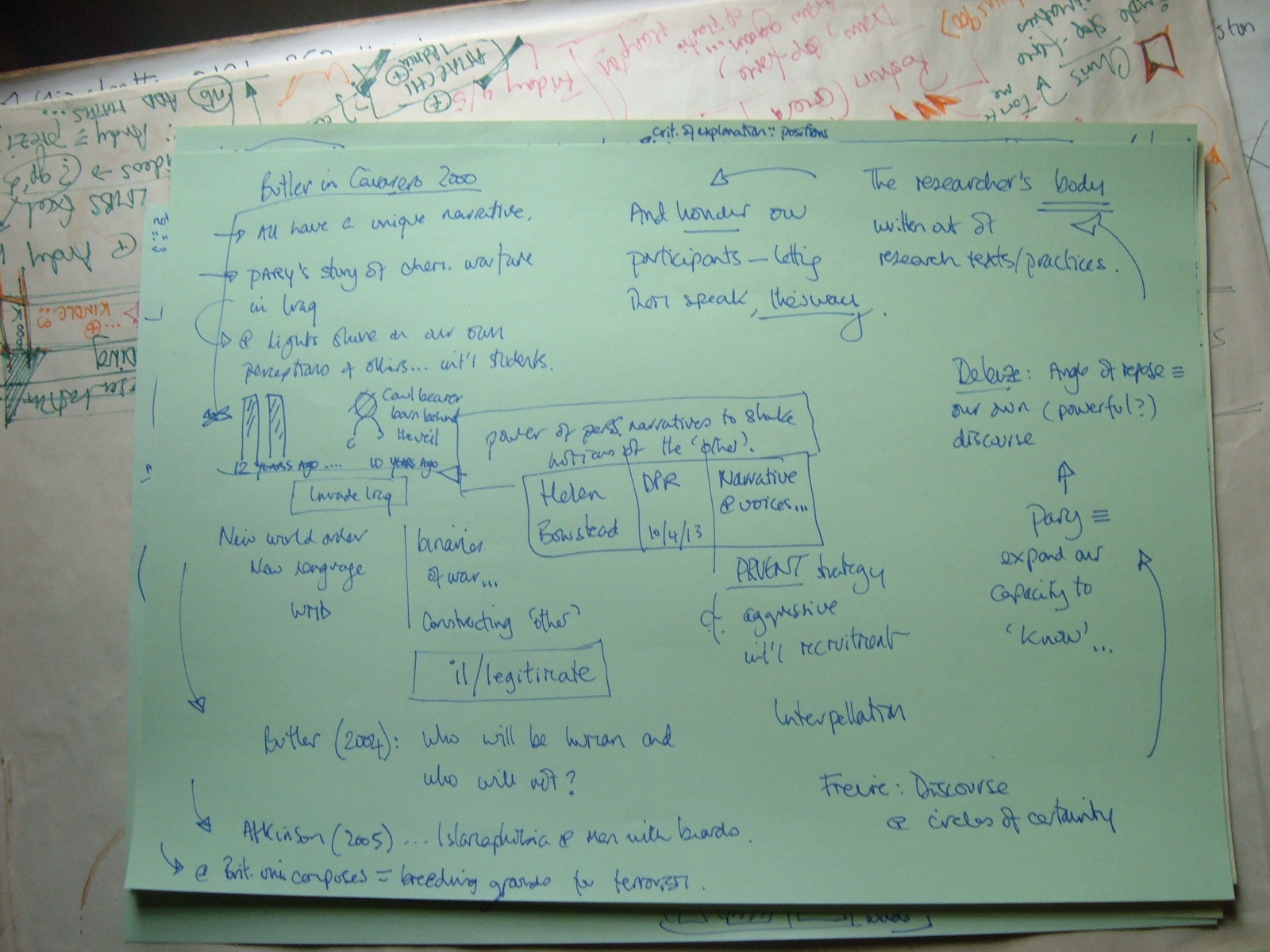
Helen Bowstead, also from Plymouth, discussed ‘the power of personal narratives to shake notions of the ‘other’’.

Drawing on Butler (2000) and Deleuze and her own excellent work on the power of ‘transgressive narratives’ within HE teaching and research, Helen spoke poetically of ways of working with and understanding our students, including our international students, that enriched all our understandings. She extended this to the research context illustrating how her approach can bring both the researcher and the participant more ethically into the research process. The power of this session was in the poetic extracts that Helen read out – which I do not have – so if this intrigues at all – do search for Helen Bowstead’s ‘writing’ work.


Sandra Birkett from Ontario gave a breathtakingly fast and engaging presentation on her work with teenage students: ‘Critical thinking in and on assessments’

Sandra de-constructed and elaborated upon staff expectations of students when they use terms like, ‘You will be awarded marks for:
  • Knowledge and understanding
  • Thinking and enquiry
  • Communication
  • Application.’
These taken for granted terms – by staff – have no meaning for most students – even more so in a digital era of super-fast responses, bite-sized learning, multi-tasking and instant-answering. This was no process of dumbing-down but of explication and de-mystifcation that really did seem to empower students to understand what was expected of them. I would like to get the PPT of this session to show to my own University students …


Julian Ingle of QMUL, and previously of London Met, explored ‘Writing as exclusionary practice…’

I heard rumblings amongst the younger participants as Julien argued against the privileged position of writing in the University assessment landscape. Writing tasks are proliferating with ancillary writing tasks sprouting like weeds and reinforcing prejudice against those, including those with various SpLDs, who find writing difficult. Julien suggested mildly that all students are offered more choice as to the way they would like to be assessed and asked us to consider how we might challenge the pre-eminence of writing and what alternative assessments might look like.


Almost in response to Julien, Zotzman and Hernandez-Zamora from Mexico argued for ‘Digital literacy as a tool for self-authoring…’

Perhaps unsurprisingly the Mexican public university system is as divided as the UK one with private universities well-resourced and heavily fenced – whilst the public sector is under-funded and attended by w/class students regulated and controlled by exclusionary practices such that even if they do produce a final dissertation – their voices will never have been heard and will not be visible in their own work. The re-authoring and re-genring work that Z and H-Z undertook with their students drew on Bakhtin (1981), Kress and Van Leeuwen (2001) and Kress (2010)  - arguing that words are only our own when we populate them with our own weight and that the affordances of multimodality offers agency, voice and expression… Examples included producing illustrated A-Z after Dahl and seemed to have empowering and transformative effect. This is another PPT that I would like to get so that I could under-take such work with my own students.


A powerful dialogic reply came from Choi who argued for ‘Using autobiography as pedagogy’

Choi encountered resistance when seeking Hong Kong w/class students to write autobiographically of their educational experiences. The power of this session, as with Bowstead’s, came from the poetic power of the student voices. Heartbreaking to hear the implicit internalised self-loathing of: ‘I got no cultural capital from my parents’. These bleak and desolate, to me, autobiographical extracts illustrated again the symbolic violence enacted on more communal and collective social groups when engaging in neo-liberal, individualistic education systems.


Simon Bell from Coventry School of Art and Design shared his PhD research work: ‘short odds = safe bet: go on, you know it makes sense’

Bell devised a range of creative, very short writing tasks for his students – the 300 word essay, the 120 word short story, the eight line detailed argument… An analysis of the student writing revealed the potential of these short writing tasks to engage and challenge the writer – to provoke and produce inspired and inspiring writing – and to reveal the potency of academic and professional literacies to even foundation students. We participated in group writing as part of the workshop – struggling to produce sixty words to answer an essay question on the positive nature of luxury – the other table were arguing for the luxury of freedom. It was truly engaging and stimulating to draft and re-draft – to really shape and craft – an answer in so few words. Again, I have discovered an emancipatory practice – I have never seen an activity deliver so well on the intended promise.


Our session followed Bell and concluded the Conference. We argued for the virtual as a ‘third space’ with emancipatory potential for teaching and learning. Bell and our sessions complemented each other – and we hope to work with Bell in some way as an outcome of the Conference.

Burns, Sinfield, Holley and O’Reilly: ‘Third Space – the final frontier? Disrupting learning landscapes, renegotiating pedagogic spaces’

Our proposal was predicated upon our belief that Education is in transition - commodity driven, marketised, rationed and controlled in ways that we have arguably not seen since the days when only the ‘top’ seven per cent went to University.  And wondered how can we be challenging, creative and yet more inclusive in these ‘interesting’ times. Winnicott (1971) argued that play is important in counteracting the implicit threat that occurs when we are in transitional spaces – between worlds, between social classes and in alien educational settings.  We wanted to see if we could playfully:
  • Disrupt concepts of educational spaces -  and use space differently
  • Devise authentic assignments and engaging pedagogy
  • Promote students as actors and agents
  • Occupy, name and yet liberate new pedagogic and virtual spaces?
We created alternative educational spaces in Second Life, a 3D immersive world (www.secondlife.com), to see if students inhabited these disrupted spaces in more powerful ways than the traditional lecture hall or seminar room. Our educational landscape became a seashore with sussurating sea, deck chairs, bonfires and puzzle cubes. We found that our students appeared as Bee or Klingon as well as ‘Barbie on the Poop Deck’ – and argued that disrupted pedagogic space can allow for more powerful student agency… Our more recent work (elaborated upon in the blog post below) argues for creative pedagogy and assignments – including the design and production of digital artefacts as alternative, empowering assignments.

I found this DPR really engaging, exciting and inspiring – I left with memories of creative and stimulating people and practices – with so many new things to do and try out and – hopefully – with a few more people out there with whom I might collaborate and cooperate in the future.