Showing posts with label Deleuze. Show all posts

Friday, 28 March 2014

W10: #rhizo14: Disrupting learning: Creativity in arid landscapes

Creativity and the art of thriving in arid environments (Mar 22 - 30)
And the Trickster spake: After a couple of days required for a creative break, here it is Week 10! In thinking about the topic that I would propose for Rhizo14, the mental image that came up was a desert, and Dave Cormier's evil Japanese plant that grows like crazy. Of course, I wasn't quite sure what to make of this mental image, until I asked the all powerful crowds in the facebook group and it seemed to be that creativity was a topic that many people wanted to tackle. So here we go, Creativity: The Art of Thriving in Arid Environments.
This topic is wide open, it can be about your own personal creativity in education, it can include face to face and online, it can be about any subject - not just art. For instance, how does one creatively move through obstacles in their own organization in order to improve that organization? How do students stay within confining rubrics yes exert their own creativity in their assignments? How do you, as a designer or instructor, act creatively to meet those institutionally mandated goals and objectives for you course while giving your learners something they can sink their teeth into and be engaged through creativity in their learning endeavors?
To bring this to the MOOC realm, xMOOC platforms seem like dry and arid places, all of the creativity has been seemingly sucked from these platforms in favor of video based education. How do you break those system? use them creatively to create engaging xMOOCs? Will they still be xMOOCs if you do something creative with them?
How do YOU see creativity, and how would you respond to a criticism of creativity?


Hey you – don’t touch that – touch this!
We are learning developers (LD) and educationalists teaching mostly F2F – so here’s a response from that perspective rather than from a MOOC one. A big aspect of LD work is to help especially ‘non-traditional’ (NT) students become familiar with and powerful within the exclusionary practices of HE. If we were being Deleuzian (1987, 2005) but critical – we might argue that we were re-territorialising that student to enable them to participate successfully in HE (see arguments about skills – socialization – academic literacies, Lea & Street 1998). More hopefully our new Year-Long Becoming an Educationalist module creates spaces, fissures and cracks for students not traditionally welcome in the academy – spaces for them to re-territorialise as educational nomads.

We wanted our course to both empower students and to critique the reductive nature of education per se. Our fish swim in educational currents composed of the over-riding narratives of assessment, SATs, League Tables, OFSTED and other inspection regimes, moral panics about plagiarism – and the ‘dumbing down’ of education (viz. that great Starkey quote on our University: there are Mickey Mouse students for whom Mickey Mouse degrees are quite appropriate). It is an education system moulded by neo-liberalism and, in the UK, the sense that the market will solve all our problems.

Our module was designed to empower in and of itself – and to act as a tool or lens to critique reductionist education and reductionist curricula. The module includes some direct didactic teaching alongside active and engaging learning: Role playing and simulations; Creative and visual learning strategies, see http://learning.londonmet.ac.uk/epacks/look_make_learn/; Inquiry Based and Problem Based Learning; Reflective learning; Drawing, Poetry and Prose analysis and discussion; Analysis of Educational Policy documents; Research projects; Resource/artefact production; #ds106 and development of a digital self; Peer Mentoring; Contribution  to the University’s annual student-facing Get Ahead conference http://learning.londonmet.ac.uk/epacks/get_ahead_conf/

Students are expected to talk, listen, discuss and be with (Jean Luc Nancy) each other; they are expected to attend Music improvisation and Dance workshops – and to design and present their own interactive workshops. They are expected to make notes, read actively and interactively and share their findings – and also to produce collages, blind drawings, conference presentations, real research and digital artefacts. We hope that they join in with energy and enthusiasm to all the different things that they are asked to do – and then to make the learning conscious… especially in their blogs.

Narratives of the self: a space for real writing
There is much research, both anecdotal and more formal, on the fear that academic writing holds for students. In a study at our own University Burn, Burns and Sinfield (2004) found that even successful PG students said:
‘I’m still not sure if my writing is academic. I still don’t know what makes one essay better than another.’
‘I’ve been humiliated in ways that I wouldn’t have put up with anywhere else.’
Arguably the academic essay as a genre exemplifies academic writing per se: non-polemical in form yet inviting certainty of argumentation whilst excluding the personal, the emphatic, the confused, the flippant and the humorous. But these traits can all be valued parts of the individual – needed especially when coping with the implicit threats inherent in transition (Winnicott 1971) into formal academic spaces that traditionally exclude people from certain social, economic and cultural backgrounds. It could therefore be said that writing in the academy acts as a metonym for the academic: implacable, reified, classed. It is the space where our students most feel like ‘a fish out of water’. They are, as with Bowstead’s (2011) student, ‘coming to writing’ passionate, opinionated and eloquent verbally; but ‘we can’t speak as we write’, especially not in an academic environment. This boundary-crossing module is designed to help students enter not only the academic world per se, but also that most tricky academic form - academic writing - including by the quasi-academic writing of the reflective learning log or blog.

Can you blog it?
We presented the reflective log and the Blog in particular to the students as quasi-academic and semi-public space. We wanted to invite ownership: this writing matters – because you have something to say. It is a space to perform one’s self as it becomes academic – and to perform that more wholly than in an academic essay. In both log and Blog you can be playful (Winnicott 1971) – and it is play we need to tackle the threat implicit in transitional spaces – those becoming spaces (Deleuze 1987, 2005) – and it is in play that we are wholly fiercely alive – and fiercely ourselves. We, as with Bowstead (2011) note that in our students all the passion – all that energy – all their power is deemed invalid in the academic essay: it becomes transgressive in and of itself. We hoped that the logs and the Blogs allowed the passion and the play – and that our students would utilize these lines of flight (Deleuze 1987, 2005) to narrate a more powerful self.

Lines of escape/Lines of flight
In stark contrast to the formality of the academic essay, narratives and more personal writing, and multimodal Blogs especially, can constitute the cracks – the boundaries – the borders - the space for disruption, irruptions and eruptions: the place of collision and encounter. Those representations become where space and time collapse – compressed – intensified – because finite – become finite – existing in a fixed placed and time. Their composition emerges from a compressed space, time and setting: meaning and communication become one narrative. And (as Deleuze might argue) this offers an opportunity not to re-trace the compilation of the sign – but a moment – just before it becomes fixed – when all the potential and possibilities still exist. A moment of and for transformation – for recognition of the self … A crack in space and time to re-territorialise educational spaces – to become educational nomads (or as we say in #rhizo14, Knowmads).

Check out Mo’s blog on that A-Maze-ing thing: http://moa1484.wordpress.com/2014/01/28/a-maze-ing/

References (in progress)
Bourdieu
Bowstead, H., 2011. Coming to writing. Journal of Learning Development in Higher Education, [online] Available at:
Brande, D., 1981/1934. Becoming a writer. Los Angeles: J. P. Tarcher.
Burn, Burns and Sinfield (2004) ‘Writing Resistance’ in Discourse Power Resistance Conference, Plymouth University 2004
Burns, T. & Sinfield, S., 2012. Essential study skills: The complete guide to success at university. 3rd ed. London: Sage.
Deleuze G and Guattari F (1987, 2005) A Thousand Plateaus: Capitalism and Schizophrenia Minneapolis, London: University of Minnesota Press
Elbow, P., 1975. Writing without teachers. New York: Oxford University Press.
Herrmann, N., 1989. The creative brain. Lake Lure, NC: Brain Books.
Freire – mentoring
Freire and/or Giroux – emancipatory education
Kossak, S., 2011. Reaching in, reaching out: Reflections on reciprocal mentoring. Bloomington, IN: Balboa Press.
Lea and Street (1998)
Nancy J-L DATE
#rhizo14 (2014) MOOC: The Community is the Curriculum (Dave Cormier via P2PU https://p2pu.org/en/courses/882/content/3154/ )
Sinfield, Burns and Holley (2003)

Winnicott, D., W., 1971. Playing and reality. London: Tavistock.

Thursday, 20 February 2014

#rhizo14: W5: Community as Curriculum: Poetry as a Mode of Inquiry?

Rarely have I been so time poor – sad that it coincides with my engagement with the brilliant #rhizo14 led by Dave Cormier. This one might be a MOOCers MOOC: there is no set reading – scant introductory remarks – no trail of video tutorials or lectures… just trickster questions designed to get us thinking – posting – commenting – blogging – FBing – Google+ing… and lo – the community IS the curriculum. It is emergent – it emerges – it is what we want it to be! This post is a little reflection - and an invitation - let us write some poetry as a collaborative means of researching #rhizo14?


Declare
My project – if you can call it that – for #rhizo14 has been to bring as much of this busy fizzy messy stuff as possible into my first year #becomingeducational module and see what it sparks in first year students who in the end want to become educationalists.
In the process I have shared DogTrax ‘Steal this Poem’ (http://dogtrax.edublogs.org/2014/01/16/rhizo14-steal-this-poem/) and with him used the concept of cheating as a tool to analyse the power structures of education. I have re-blogged several #rhizo14 blogposts directly to the handful of students who actually follow the class blog. I don’t know if the excitement sizzles through – but I hope so!
Research: Collaborative writing as inquiry
Some of us in the rhizome are exploring the idea of collaborative writing as a form of inquiry about #rhizo14. We are thinking about exploring (as radical un-content) the blogs that have emerged – the words that have touched us, weaving a paper in, around and through our own responses to the ones we choose – and our responses to the writing of our fellow flaneurs.
In this, I have been very influenced by Ken Gale – who has himself studied Deleuze through collaborative writing…  (see Ken Gale http://www.aldinhe.ac.uk/ojs/index.php?journal=jldhe&page=article&op=view&path%5B%5D=222 )
Poetry and Inquiry?
Given the power of the rhizome – and the huge creativity in this ‘wonder’ (my collective term for us all – rejecting community – network – group); do #rhizo14ers want to generate poems (in the broadest and most multimodal sense) of our experiences – either as our own collective mode of inquiry for capturing (dead word!) our collective learning – that could be posted on a #rhizo14 website for just that purpose???
OR - for the LinkedIn Group: Higher Education Teaching and Learning and their Call for poems and creative works. Confession – I haven’t performed a rigorous back check on all this – but it serendipitously appeared in my email in-box from a friend who knows I like this sort of this. I am sharing it with a community that I know also loves this sort of thing…

Anyway – here’s their invitation - Submission Deadline: June 20, 2014:
Teaching as a Human Experience: An Anthology of Contemporary Poems
An edited anthology volume by Dr. Karen Head (Assistant Professor in Georgia Tech’s School of Literature, Media, and Communication), and Patrick Blessinger (Founder and Executive Director, Higher Education Teaching and Learning Association)

Volume one of the anthology series, Contemporary Teaching and Learning Poetry Series, Patrick Blessinger, series editor.

Submissions should be submitted electronically to:


https://www.hetl.org/poem-submission-form/ 

Volume One Overview

The poems in this collection will deal with the real life-worlds of professors, instructors, and others working in education and it will cover contemporary teaching experiences in education. The poems will be written mainly by college and university professors, instructors, lecturers, and others in the field of education, and will cover the many roles teachers play, including instructing, lecturing, mentoring, facilitating, coaching, guiding, and leading. This volume will cover the manifold life experiences and perspectives of being and working as a teacher in education and the epiphanies (experiences of deep realization) experienced in that role.

This volume seeks to give creative voice to the full range of experiences by teachers, students, and others. It seeks to empower readers with personal agency as they evolve as self-creating, self-determining authors of their own lives, personally and professionally. In short, it seeks to expand our consciousness of what it means to be a teacher in contemporary life and within diverse learning environments and cultures. The poems will be based on teachers’ meaningful experiences in and out of the classroom and will provide artistic inspiration and creative insight to other teachers who work as teachers.

Submission Requirements

You may submit up to two poems or creative works per person. Any poetic form is accepted, but each poem should be limited to 300 words, unless the poem of longer length is exceptional in quality and highly unique in insight or style and appropriate to the poetic form used. Thus, poems and creative works expressed in a pure economy of words and that are able to distill the human experience down to its bare essence are highly valued as are creative use of voice, passion, imagery and the interplay of intellect and emotions.

The poem “Lecture” by Tami Haaland and the poem “Student” by Ted Kooser are a few examples of the type of work this volume seeks.

Submissions

We invite submissions of high quality poems and creative works for Volume One entitled, Teaching as a Human Experience: An Anthology of Contemporary Poems. We are interested in poems by teachers (e.g., professors, instructors, lecturers, faculty) as well as other practitioners in the field of teaching and learning.

Submission Deadline: June 20, 2014

Submissions should be submitted electronically to:

https://www.hetl.org/poem-submission-form/ 

Friday, 17 January 2014

#rhizo14: the Community is the Curriculum

This week I sort of started two MOOCS – NovoEd’s Storytelling for Change and Dave Cormier’s Rhizomatic Learning: #rhizo14: The Community is the Curriculum.
I had a go at both of them – and they do both look good. BUT – I’m only going to proceed with #rhizo14 – it is more flexible and self-directed – it is setting us free to work together - and I already know and like quite a lot of the other participants.
Here’s some info on Storytelling for change in case it appeals – then I will paste in some cool stuff about #rhizo14 – including links to some of the best blogs that I’ve already stumbled across.
#storytelling-change
Home:
Key Learning Outcomes
By the end of this course, participants will:
Be confident in using stories, especially personal stories, as part of their communication toolkit.
Know how to tell stories and use a specific set of storytelling skills so that they connect with the hearts and minds of their audiences (an audience of one or many).
Have developed, rehearsed, and received feedback on one personal story as a replicable model so that they can build a personal “library” or “back pocket” of stories that can be used in different situations.
Be able to use a 5-step process to integrate story into presentations for change, work, or many other situations.
Forums:

#rhizo14: And so it begins:
The tour:
The FB group:
Dave’s opening blog posts thoughts:
“Rhizomatic Learning posits, among other things, that the community is the curriculum. That being able to participate with and among those people who are resident in a particular field is a primary goal of learning. In each of my classes the curriculum is, of course, filled with the ideas and connections that pre-exist in the field but the paths that are taken by the students are as individual as they are, and the path taken by the class is made up of the collected paths chosen by all the students, shaped by my influence as an instructor and the impact of those external nodes they manage to contact.”

Week 1 Things to do:
Introduce yourself, follow one of the threads of discussion somewhere. Comment on someone's work. Get acclimated.
Week 1 Challenge - Use cheating as a weapon. How can you use the idea of cheating as a tool to take apart the structures that you work in? What does it say about learning? About power? About how you see teaching?
Bonus - Do lots of rhizomatic teaching? Tell us about it.
Some cool blogs:
Emily P: un content ed – Blog http://t.co/E00BGoyCsi Challenge everything!
This fits:
Failing Superman: http://t.co/6aDQHGGhts - curriculum as endurance.
As does this:
Everything is a re-mix: http://t.co/LjNmTlLvRa - especially the richly textured beginning.
I just love this:
Irrational art series: http://danariely.com/2012/06/15/creative-dishonesty/ Not dishonesty as much as a really cool research method.
And @dkernohan’s daily create challenges: http://t.co/OQ6j7uUMpp 
A big takeaway for the weekend:
And if you’re holding back cos the tech scares you… this PPT essay on technology made me smile: http://t.co/Q3IzZMjufF

But the best note on cheating to learn comes from Ary’s wonderful blog: A small plot of land (http://fearlesstech4teachers.wordpress.com/):
I am a former high school teacher with rhizomatic tendencies so I have been at war with public education for the last 20 years, defending my students’ right to think, question, create and express themselves, so hell yeah I’ve cheated! …for one I never taught from a textbook or assigned a workbook. I always got to know my students to discover what they wanted to read and write about. I asked them what they wanted to learn, and I listened. …It took months to set up this type of infrastructure and culture in my classroom, and honestly there were always those students and (their parents) who preferred to passively learn, answer questions at the end of the chapter, or complete a worksheet than to rewrite, remix and modernize an act of Romeo and Juliet, podcast it, or perform it live for their classmates. Some people prefer traditions. It‘s safe. My students took risks.  They weren’t students; they were actors, producers, writers, directors, poets, pod-casters, radio show hosts, bloggers, analysts, reporters, detectives, mentors, lawyers, teachers, game show hosts, artists, mimes…they did it all!  They created “stuff” all the time…”

Frankly in awe of Ary here for being able to do this in the public education system, and for younger students. I like to think that I managed a fraction of this in my evening A’level classes, mainly attended by adults wanting to wrestle with Shakespeare and Chaucer. I definitely try to mix it up in my University classes … but against the sheer monolithic power of state education ???!!!!! That is an achievement!

Right now we (my partner Tom Burns and I – with Quaco Cloutterbuck) are running ‘Becoming an Educationalist’ (http://becomingeducational.wordpress.com/). Deleuzian in form and content, we’ve started to de-territorialise – we are nomads – we are taking our lines of flight – and our lines of escape… 

Friday, 12 April 2013

Discourse, Power and Resistance 2013


The friendly yet challenging and stimulating Education conference was at Greenwich again:

We were presenting in the Symposium strand: ‘Stimulating or stultifying? Teaching as if education matters’, organised by Eloise Sentito, from Plymouth University’s Learning Development Team.

There were three excellent Key Note speakers across the three days: Roger Slee, Diane Reay and Bev Skeggs. Roger Slee spoke on the myth of ‘inclusion’, creating a poetic tapestry of references to underscore his points. (Unfortunately I have already shared my notes on his session with colleagues who are interested in Special Needs education so I cannot make detailed reference to his talk here and now.)

Diane Reay, Cambridge University, and previously from my own Alma Mater, London Met, gave a sharp focused key note: ‘Outsiders on the inside: the continuing power of working class exclusion’.

Diane spoke of the current scholarisation of childhood – with a middle class agenda which confers and reaffirms privilege on that class whilst setting up a climate of pathology and blame around working class failure in education.  For the w/class, school offers a mirage of opportunity whilst constructing collective disappointment which is painful and shameful; constructing psychological and social damage. In this system the working class child is systematically and collectively constructed as worthless whilst being individually blamed and stigmatised for their poverty, financial and aspirational; their failure; and their silence. The new hidden curriculum of this age of ‘education’ is the inculcation and normalising of a neo-liberal agenda which for the working class becomes internalised as self-hatred and self blame. Reay argued that our political elites put a lot of class work in to their policies and in ensuring that the w/class are forever and always (blamed for being) educational losers.


Bev Skeggs’ fascinating and engaging key note reported on her ESCR project: ‘Making class and self through televised ethical scenarios’, which focused on constructions of the shameful (working class) self through reality television (RTV) (www.identities.org.uk).  This was a wonderful consideration of the intended class work of RTV – and a making conscious of the oppositional readings that we can make, aware as we are of the intended manipulation of this melodramatic form. Great points about the ‘moral economy of person production’, the ‘forensic gaze’ of RTV and, as with education, how the w/class are individually blamed and shamed – and invited to aspire to individual transformation at the hands of all powerful experts – whilst structural inequalities and symbolic violence is hidden, denied.


Seminars and workshops
Eloise Sentito: Leader of the Symposium Strand: ‘Stimulating or stultifying? Education as if learning matters’ – kicked off our Symposium strand…

You might notice that is a slightly different title to the one that I keep returning to – but I have left both in this post – cos they capture some healthy tensions in our strand: In terms of a stultifying education, how far is the teacher the issue? How important is teaching? What is the role of learning? What ‘work’ is being done by the new learner-centred rubric?

Eloise’s workshop was entitled:
Vortex street dynamics in teaching and learning: conceptualising intellectual relationships’

Eloise opened with: ‘there is stultification whenever one intelligence is subordinated to another… whoever teaches without emancipating stultifies’ (Jacques Ranciere: The Ignorant Schoolmaster pp13, 18)… and went on to consider the different intellectual models offered by Socrates; Giroux, Rousseau and Dewey; Freire; Ranciere; Learning Development; Peer Assisted Learning. Eloise illustrated these models with drawings of different circles, spirals and vortices – and we were invited to produce visual or three-dimensional models for ourselves. Discussing our different illustrations allowed us to make conscious implicit attitudes to teaching and learning to stimulate further discussion on what teaching is for, how we as teachers interact and work with students – and whether teaching can ever be emancipatory.


In a dialogic conversation with Eloise, Gert Biesta’s session argued that despite the ignorant schoolmaster:  ‘… Teaching (still) matters in emancipatory education’

Biesta offered Mollenhauer (1968): education is not necessary for emancipation – but it may contribute… and thus considered the education model that would facilitate this. This was a rigorous and stimulating session previously offered as a key note and one that I would love to see again, perhaps at our own L&T conference or even at #aldcon…  The conclusions offered were that what makes us human rather than robots is that we can be addressed, interrupted and taught by others. This is something to celebrate rather than to apologise for. Emancipatory education is not the transmission or revelation of a truth, nor even freeing ourselves from power or an alienated existence – but rather the revealing of an intelligence to itself. It is an emancipation from a self-understanding of being incapable and voiceless – with equality not a product but an underlying assumption.


Heneke Jones considered fostering meaningful dialogue and dialogic space in the primary classroom – and in the Education Studies one, with: ‘Dialogue, disagreement and disaffection: squaring the circle’

The opening proposition here was: ‘I disagree with myself’ and Heneke explored philosophical thinking in the primary school as a facilitator for creative thinking within a community of enquiry. She offered a lovely model for generating questions drawn from Baumfield, Higgins and Leat (2001):
  • Setting the scene
  • The stimulus scenario (here the audience recommended straying beyond m/class centric ones and suggested extracts from ‘The Simpsons’
  • Thinking time
  • Q-making
  • Q-airing
  • Q-choosing
  • 1st thoughts
  • Building of enquiry
  • Last words
  • De-brief.
Her research explored patterns of dialogue within this mode of enquiry – and I thought that the model for generating questions would work well within University settings.


Kassandra from Plymouth Dyslexia Services explored academic reading with students with dyslexia. Her key proposition was that the person with dyslexia is a curious visual reasoner – who is made to feel ‘too stupid to learn’ within the education system. She argued that the dyslexic is consumed by anxiety, exhausted by continuous self-monitoring and the sense that the locus of control for their learning (and their lives) was always elsewhere. I took from it another argument against the imposition of de-contextualised phonics work in the primary classroom – arguing as she did for the need to use whole words that can be understood through context and meaning…


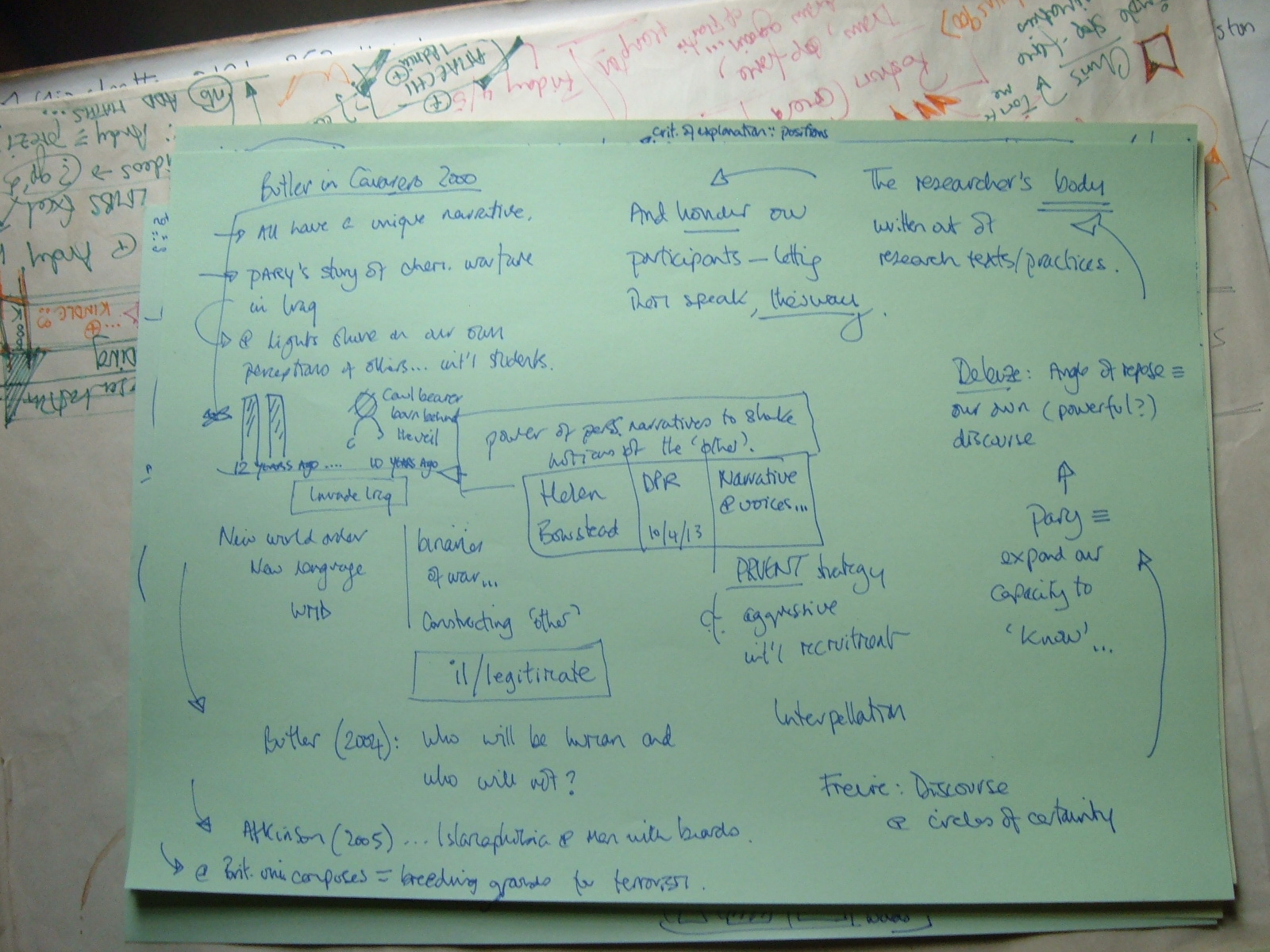
Helen Bowstead, also from Plymouth, discussed ‘the power of personal narratives to shake notions of the ‘other’’.

Drawing on Butler (2000) and Deleuze and her own excellent work on the power of ‘transgressive narratives’ within HE teaching and research, Helen spoke poetically of ways of working with and understanding our students, including our international students, that enriched all our understandings. She extended this to the research context illustrating how her approach can bring both the researcher and the participant more ethically into the research process. The power of this session was in the poetic extracts that Helen read out – which I do not have – so if this intrigues at all – do search for Helen Bowstead’s ‘writing’ work.


Sandra Birkett from Ontario gave a breathtakingly fast and engaging presentation on her work with teenage students: ‘Critical thinking in and on assessments’

Sandra de-constructed and elaborated upon staff expectations of students when they use terms like, ‘You will be awarded marks for:
  • Knowledge and understanding
  • Thinking and enquiry
  • Communication
  • Application.’
These taken for granted terms – by staff – have no meaning for most students – even more so in a digital era of super-fast responses, bite-sized learning, multi-tasking and instant-answering. This was no process of dumbing-down but of explication and de-mystifcation that really did seem to empower students to understand what was expected of them. I would like to get the PPT of this session to show to my own University students …


Julian Ingle of QMUL, and previously of London Met, explored ‘Writing as exclusionary practice…’

I heard rumblings amongst the younger participants as Julien argued against the privileged position of writing in the University assessment landscape. Writing tasks are proliferating with ancillary writing tasks sprouting like weeds and reinforcing prejudice against those, including those with various SpLDs, who find writing difficult. Julien suggested mildly that all students are offered more choice as to the way they would like to be assessed and asked us to consider how we might challenge the pre-eminence of writing and what alternative assessments might look like.


Almost in response to Julien, Zotzman and Hernandez-Zamora from Mexico argued for ‘Digital literacy as a tool for self-authoring…’

Perhaps unsurprisingly the Mexican public university system is as divided as the UK one with private universities well-resourced and heavily fenced – whilst the public sector is under-funded and attended by w/class students regulated and controlled by exclusionary practices such that even if they do produce a final dissertation – their voices will never have been heard and will not be visible in their own work. The re-authoring and re-genring work that Z and H-Z undertook with their students drew on Bakhtin (1981), Kress and Van Leeuwen (2001) and Kress (2010)  - arguing that words are only our own when we populate them with our own weight and that the affordances of multimodality offers agency, voice and expression… Examples included producing illustrated A-Z after Dahl and seemed to have empowering and transformative effect. This is another PPT that I would like to get so that I could under-take such work with my own students.


A powerful dialogic reply came from Choi who argued for ‘Using autobiography as pedagogy’

Choi encountered resistance when seeking Hong Kong w/class students to write autobiographically of their educational experiences. The power of this session, as with Bowstead’s, came from the poetic power of the student voices. Heartbreaking to hear the implicit internalised self-loathing of: ‘I got no cultural capital from my parents’. These bleak and desolate, to me, autobiographical extracts illustrated again the symbolic violence enacted on more communal and collective social groups when engaging in neo-liberal, individualistic education systems.


Simon Bell from Coventry School of Art and Design shared his PhD research work: ‘short odds = safe bet: go on, you know it makes sense’

Bell devised a range of creative, very short writing tasks for his students – the 300 word essay, the 120 word short story, the eight line detailed argument… An analysis of the student writing revealed the potential of these short writing tasks to engage and challenge the writer – to provoke and produce inspired and inspiring writing – and to reveal the potency of academic and professional literacies to even foundation students. We participated in group writing as part of the workshop – struggling to produce sixty words to answer an essay question on the positive nature of luxury – the other table were arguing for the luxury of freedom. It was truly engaging and stimulating to draft and re-draft – to really shape and craft – an answer in so few words. Again, I have discovered an emancipatory practice – I have never seen an activity deliver so well on the intended promise.


Our session followed Bell and concluded the Conference. We argued for the virtual as a ‘third space’ with emancipatory potential for teaching and learning. Bell and our sessions complemented each other – and we hope to work with Bell in some way as an outcome of the Conference.

Burns, Sinfield, Holley and O’Reilly: ‘Third Space – the final frontier? Disrupting learning landscapes, renegotiating pedagogic spaces’

Our proposal was predicated upon our belief that Education is in transition - commodity driven, marketised, rationed and controlled in ways that we have arguably not seen since the days when only the ‘top’ seven per cent went to University.  And wondered how can we be challenging, creative and yet more inclusive in these ‘interesting’ times. Winnicott (1971) argued that play is important in counteracting the implicit threat that occurs when we are in transitional spaces – between worlds, between social classes and in alien educational settings.  We wanted to see if we could playfully:
  • Disrupt concepts of educational spaces -  and use space differently
  • Devise authentic assignments and engaging pedagogy
  • Promote students as actors and agents
  • Occupy, name and yet liberate new pedagogic and virtual spaces?
We created alternative educational spaces in Second Life, a 3D immersive world (www.secondlife.com), to see if students inhabited these disrupted spaces in more powerful ways than the traditional lecture hall or seminar room. Our educational landscape became a seashore with sussurating sea, deck chairs, bonfires and puzzle cubes. We found that our students appeared as Bee or Klingon as well as ‘Barbie on the Poop Deck’ – and argued that disrupted pedagogic space can allow for more powerful student agency… Our more recent work (elaborated upon in the blog post below) argues for creative pedagogy and assignments – including the design and production of digital artefacts as alternative, empowering assignments.

I found this DPR really engaging, exciting and inspiring – I left with memories of creative and stimulating people and practices – with so many new things to do and try out and – hopefully – with a few more people out there with whom I might collaborate and cooperate in the future.