Showing posts with label #aldcon. Show all posts

Thursday, 24 April 2014

#becomingeducational W26: Crisis what crisis?

This week Quaco led the lecture session with a cracking account of the real purpose of research – making connections with your Research Project – and especially with the Research Report that everybody had to write to finish off this part of the analytical process. This Report and this process is not a pointless assessment hoop to jump through!

The point of research is to investigate an aspect of our world and then to tell people about what we did, why we did it – what we discovered – what it might mean – and what practical applications it has in the world.


There’s no point in keeping research to yourself!
In Education particularly it helps us all if research relates to our real experiences – it all makes much more sense when we know what is happening and why – if we can see a practical purpose to the work. And that is the point of this Research Project. You were asked to investigate an issue or an aspect of teaching and learning that you found interesting. You are supposed to use your interest to help you do the work. You are supposed to use that interest to help you make sense of your findings: you should know WHY you were investigating what you did – so you should know WHAT you want to tell the world about what you have discovered.

So – one last time: The Report
The Report part of this Project is where you report your findings – you discuss what the raw data might mean – you draw conclusions as to their relevance to *this* context (for you were analysing an aspect of HE study) – and where applicable you make Recommendation for Practice, that is, suggestions for how to improve the learning for University students, based on your analysis of your research data:
Findings
Discussion
Conclusions
Recommendations for Practice
Bibliography

Try to stop worrying about this as ACADEMIC WRITING – try to stop worrying about this as an ASSESSMENT – try to think about it as having something to SAY to REAL PEOPLE.

Of your RESEARCH PROPOSAL that would have been asking:
So what are you going to investigate? - INTRODUCTION
Why are you interested in that topic? – BACKGROUND/CONTEXT
What have other academics already discovered about that topic? – LITERATURE REVIEW
How will you carry out your own research? - METHOD
Why have you chosen to carry out the research in that way? - METHOD

Of your RESEARCH REPORT they will be asking:
So what happened when you conducted your research? What are the key highlights? – FINDINGS
What do your findings mean? – DISCUSSION
What overall conclusions do you draw about University teaching/learning? – CONCLUSION
What should we do differently because of what you have found out? – RECOMMENDATIONS

Okay – so it is all in just 1000 words! So no room for a lot of description – but quite a lot of *concise* analysis and discussion required.

AND – if you are still struggling with this – talk to other people in the class – what is baffling when we are alone with our worries becomes sensible and do-able when we work with other people!!

BUT if you do not want to talk to anyone – read some educational research and see how other people write it up. As we have mentioned before – the free online journal: Journal of Learning Development in Higher Education covers exactly the sort of research that you are doing – and will offer excellent models for how you should write up your work: http://www.aldinhe.ac.uk/ojs/index.php?journal=jldhe

Conference session
This week in the Workshop time, students had the option of continuing to work on their assignments or attending a session where we shared our Conference  presentation. This year we presented at the Association for Learning Development in Higher Education Conference upon the topic of blogging your learning – with a particular focus on the blogging that we have asked you to do here in the Becoming module.

The workshop was a chance for us to show you what a formal academic conference presentation might look like – and to show you the sort of research that we engage in as educationalists ourselves. If you missed the Workshop – or would like to find out a bit more about the conference itself – please go to our Least Refuge blog: http://lastrefugelmu.blogspot.co.uk/2014/04/aldinhe-conference-2014-learning.html. It would be great if you popped in a Comment or some feedback!


Wednesday, 23 April 2014

ALDinHE Conference 2014: Learning Development spaces and places

Spaces and Places
This year’s ALDinHE Conference took place in – and was facilitated by Huddersfield University: http://www.aldinhe.ac.uk/news/6/aldinhe_conference_2014:_registration_closed.html?p=7_6
There was a full programme of workshops, events and fabulous Key Note speakers, including Lesley Gourlay and Etienne Wenger-Trayner – on the topics of:
  • Who owns Learning Development?
  • Changing Staff and Student Identities: the impact of Learning Development
  • Addressing the Marginalisation of Learning Development
  • Working Collaboratively to support Learning Development.

Communities of Practice?
Like many people in Education I have been aware of Etienne Wenger-Trayner (EWT) and his Communities of Practice arguments in theory and for many years. EWT in practice and in person was a revelation: warm, inspiring and profound in his outlining of the learning trajectory which takes us from peripheral encounters into the centre of various communities of practice – and various learning identities.

EWT locates his theory in studies of apprenticeship practice. Apprentices especially at the beginning rarely interact directly with a ‘master’ but engage more in apprentice-to-apprentice interactions. In this way learning is ineffably located in the group and in our group interactions: learning is social, embodied and whole person.

For EWT, learning experience models this apprenticeship trajectory. He described ‘learning’ as circled by complementary processes involving community (which offers belonging and a meaningful cadre with which to negotiate and define competence); practice (what we do – and how meaningful and valuable it is); meaning (that is rooted with relevance in the now – and not deferred to some indefinable point in the future); and identity (who we are becoming). In this model learning is not the transmission of a corpus of knowledge nor even a process or set of processes with which to engage with a corpus of knowledge; learning is how we negotiate a range of processes of becoming – that oscillate between the individual and the group.

Becoming
The EWT model allows us to see learning as becoming: it involves a realignment of competence and experience; it is socially defined – but personally experienced. Learning involves negotiating identity in a complex dance in complex landscapes of practice that navigate multiple tensions and meaning.  It is identity-construction in a time of super-complexity: it is a learning relationship between the social world and the personal.

The community is the curriculum
As one who is still part of the ongoing MOOC: #rhizo14: the community is the curriculum, I could not help but see parallels between the EWT model and the rhizomatic model of learning espoused by Dave Cormier – and as poetically described by Deleuze and Guattari (1997, 2005) in A thousand plateaus. Cormier - who spoke at last year’s ALDinHE in Plymouth - gave birth to our radical un-MOOC. In #rhizo14, learning is/emerges from the connections, contingent or purposeful, between the participants in the different learning spaces we inhabit – Forum, FaceBook, Google+, Twitter, Blogs, Zeega… - and which are fruitfully complicated by the diversity and complexity and internationality of the participants. It is a tricky trickster idea – but actually very helpful when we take back to our classrooms whether F2F or virtual: for to enable learning to happen we must at the very least foster human relationships between the participants.

‘I Robot’? Voices from the margins: narratives of LD in a Digital Age
Following on from EWT, and after Julia Dawson and Peter Bray speaking on ‘Peer Support reaching out beyond the institution’, from Plymouth, it was our presentation where we asked: What are the stories that students and staff tell themselves and each other about studying at University?

‘We have developed creative blended learning practice and embedded this within our Becoming an Educationalist and its paired Peer Mentoring in Practice modules. We and our students write reflective learning logs and online blogs to engage with our materials - to write to learn - and to struggle with narratives of the self in times of transition… We wish to share narrative extracts from these places of struggle, voice and play (Winnicott 1971) and discuss the lessons that we can learn about our students and our own blended practice. We also want to explore how we can celebrate and sustain such creative practices.’

How cool is that?
We were very happy to follow on from Wenger and his arguments about learning as a process of becoming – and to talk about our Becoming module and its various practices which we think facilitate these processes: Role playing and simulations; creative and visual learning strategies; Inquiry Based and Problem Based Learning; Reflective learning; Visual practices development; Poetry and Prose analysis and discussion; Analysis of Case Studies; Real research and other projects; Digital artefact and resource development; Peer-to-peer learning: both face-to-face and virtual; Student contribution to the University’s annual student-facing Get Ahead conference; Blogging and other Social Network activities to support learning (Becoming Educational blog: http://becomingeducational.wordpress.com/ and
Learning Development Blog: http://lastrefugelmu.blogspot.co.uk/).

Spaces and places/fissures and cracks
Our students swim in educational currents composed of the over-riding narratives of assessment, SATs, League Tables, OFSTED, moral panics about plagiarism – and the ‘dumbing down’ of education – for which they are personally blamed: There are Mickey Mouse students for whom Mickey Mouse degrees are quite appropriate (Starkey 2002/3). They are caught on a cultural cusp (Medhurst in Munt) negotiating tricky academic space which is more of a trickster space for them – for just how far are they supposed to lose themselves and become another in this alien landscape; and who gets to choose the transformation – and where do the boundaries lie?

Why writing? The essay – The blog
Arguably the academic essay as a genre exemplifies academic writing per se: it is non-polemical - yet invites certainty of argumentation. It is ‘your’ argument whilst excluding ‘you’: the personal, the emphatic, the confused, the flippant and the humorous. In many ways it can be seen as a metonym for the academic world our students have entered: implacable, reified, classed. It is the space where they most feel like ‘a fish out of water’.

We want our students to succeed in academic writing for it is the sine qua non (http://en.wikipedia.org/wiki/Sine_qua_non) of the University experience. But we wanted writing that was not the ultimate erasure of the self. We wanted a space where students could have something to say, could have their struggle to achieve authorship; but without the ‘jostling voices’ (Carter et al. 2009) asking them to ‘write and reference properly’ and to ‘be more academic’ – and less like the passionate, engaged and committed whole people that they are. We suggested blogging and wanted their blogs to be a powerful virtual tool – a quasi-academic, multimodal, public space in which to perform the self as it becomes academic – and to perform that more wholly than in an academic essay.

A little bit of Deleuze will do ya
Blogs especially can constitute the cracks – the boundaries – the borders - the space for disruption, irruptions and eruptions: the place of collision and encounter. Those representations become where space and time collapse – compressed – intensified – because finite – become finite – existing in a fixed place and time. Their composition emerges from a compressed space, time and setting: meaning and communication become one narrative. And as Deleuze might argue this offers an opportunity not to re-trace the compilation of the sign – but a moment – just before it becomes fixed – when all the potential and possibilities still exist. A moment of and for transformation – for recognition of the self… A crack in space and time to re-territorialise educational spaces – to become educational nomads.

And our student voices said:
‘Week 9 was all about my nightmare….drawing!
My drawings always mock me:
“Ha! I have defeated you! You may have many words, but give you a pencil, and watch the intelligence disappear! That’s not how you wanted it to look, is it? Is that a person or a tree? Dumbo!’’
In a class of five year old children, I am quite happy to display my ridiculous sketches. I explain to the children that drawing is not my strong point, and they assure me that I have done a very good job of representing the characters, props and scenery in the storyboard. However, if someone were to come in, they would be quite convinced that the children had drawn the pictures – and not the most artistically gifted children, either!
At the moment, I feel afraid of failure, but I have to remember that I have been here before. In 2011, I graduated with merit at the Barbican, from a Foundation Degree in Education: Primary Pathway. So I need to keep three things in mind:
Keep taking risks!
It will be worth all the hard work!
There are people to help me on my journey!’
                     
‘In this week’s lecture, we were subjected to a 10 minute free writing exercise. If we stopped writing, then we were to write the reason why we did so on a separate piece of paper. Seemed easy enough, but the question given was very ambiguous to us: Winnicott (1971) argued that play is necessary to           counteract the implicit threat of transitional...
“What?” I asked myself. “Who is Winnicott? What does he mean by play? Implicit threat?” I started writing, even though I had no idea what the question was asking. It took three attempts to get my writing flowing.’

‘Today has been so proactive that I hardly had the time to take down any academic notes and just kept on listening. There was a guest speaker today, Chris O’Reilly, who spoke to us about the presentation and making of a short 3 minute film and what kind of research and methods go into making and preparing for it. I was so intrigued and fascinated throughout the whole piece that it just had given me so many ideas. I was bursting to how these ideas could relate to my research project Report.’ 

Nomads all!

Talking of re-territorialising: do we want a Learning Development MOOC?
And so to Andrew Doig, Becka Colley, Carol Elston, David Mathew, Sandra Sinfield and our workshop on the nuts and bolts and why and ‘what fors’ of a Learning Development MOOC. The session had a great energy and buzz - and we are hopeful that a positive working group will emerge from those present – and from others in the LDHEN if they want to join in.

cMOOC, xMOOC, SPOOC – OOD??
There seemed to be two main approaches to our potential open online course emerging:
* Set the context: Where a group of us gather together to design and devise a course with quite formal and defined Aims and Outcomes. Different elements of the course might be 'owned', developed and delivered online by different people.

* What might be called the 'bring your own context' approach: a group gathers together and sets up a course that may or may not have formal aims and learning outcomes - but that can be experienced differently by participants depending on their own contexts, wants and needs. In this model, some participants may want to explore the philosophy, pedagogy and epistemology surrounding elements of the course - whilst others may just want a 'pick up and teach’ set of strategies...  Different elements might be delivered online by different people, with participants bringing as much to the table as the person 'running' the course that week/fortnight/month. I think that this community can manage that! 

To me this latter more of a #rhizo14: the community is the curriculum approach; and in actual fact, I do not think that these two approaches are incompatible if framed in a participative way.

Watch the www.jiscmail.ac.uk/ldhen list for developments - and if people are interested in taking part – could they email Andrew Doig: Andrew.Doig@solent.ac.uk ?


End Notes: There was more, so much more to ALDinHE – but I reckon that this is enough for a blogpost. So if anybody else has blogged – can you put the link in the Comments below – and perhaps we can have a conversation of sorts to keep the LD flag flying?

Friday, 12 April 2013

Discourse, Power and Resistance 2013


The friendly yet challenging and stimulating Education conference was at Greenwich again:

We were presenting in the Symposium strand: ‘Stimulating or stultifying? Teaching as if education matters’, organised by Eloise Sentito, from Plymouth University’s Learning Development Team.

There were three excellent Key Note speakers across the three days: Roger Slee, Diane Reay and Bev Skeggs. Roger Slee spoke on the myth of ‘inclusion’, creating a poetic tapestry of references to underscore his points. (Unfortunately I have already shared my notes on his session with colleagues who are interested in Special Needs education so I cannot make detailed reference to his talk here and now.)

Diane Reay, Cambridge University, and previously from my own Alma Mater, London Met, gave a sharp focused key note: ‘Outsiders on the inside: the continuing power of working class exclusion’.

Diane spoke of the current scholarisation of childhood – with a middle class agenda which confers and reaffirms privilege on that class whilst setting up a climate of pathology and blame around working class failure in education.  For the w/class, school offers a mirage of opportunity whilst constructing collective disappointment which is painful and shameful; constructing psychological and social damage. In this system the working class child is systematically and collectively constructed as worthless whilst being individually blamed and stigmatised for their poverty, financial and aspirational; their failure; and their silence. The new hidden curriculum of this age of ‘education’ is the inculcation and normalising of a neo-liberal agenda which for the working class becomes internalised as self-hatred and self blame. Reay argued that our political elites put a lot of class work in to their policies and in ensuring that the w/class are forever and always (blamed for being) educational losers.


Bev Skeggs’ fascinating and engaging key note reported on her ESCR project: ‘Making class and self through televised ethical scenarios’, which focused on constructions of the shameful (working class) self through reality television (RTV) (www.identities.org.uk).  This was a wonderful consideration of the intended class work of RTV – and a making conscious of the oppositional readings that we can make, aware as we are of the intended manipulation of this melodramatic form. Great points about the ‘moral economy of person production’, the ‘forensic gaze’ of RTV and, as with education, how the w/class are individually blamed and shamed – and invited to aspire to individual transformation at the hands of all powerful experts – whilst structural inequalities and symbolic violence is hidden, denied.


Seminars and workshops
Eloise Sentito: Leader of the Symposium Strand: ‘Stimulating or stultifying? Education as if learning matters’ – kicked off our Symposium strand…

You might notice that is a slightly different title to the one that I keep returning to – but I have left both in this post – cos they capture some healthy tensions in our strand: In terms of a stultifying education, how far is the teacher the issue? How important is teaching? What is the role of learning? What ‘work’ is being done by the new learner-centred rubric?

Eloise’s workshop was entitled:
‘Vortex street dynamics in teaching and learning: conceptualising intellectual relationships’

Eloise opened with: ‘there is stultification whenever one intelligence is subordinated to another… whoever teaches without emancipating stultifies’ (Jacques Ranciere: The Ignorant Schoolmaster pp13, 18)… and went on to consider the different intellectual models offered by Socrates; Giroux, Rousseau and Dewey; Freire; Ranciere; Learning Development; Peer Assisted Learning. Eloise illustrated these models with drawings of different circles, spirals and vortices – and we were invited to produce visual or three-dimensional models for ourselves. Discussing our different illustrations allowed us to make conscious implicit attitudes to teaching and learning to stimulate further discussion on what teaching is for, how we as teachers interact and work with students – and whether teaching can ever be emancipatory.


In a dialogic conversation with Eloise, Gert Biesta’s session argued that despite the ignorant schoolmaster:  ‘… Teaching (still) matters in emancipatory education’

Biesta offered Mollenhauer (1968): education is not necessary for emancipation – but it may contribute… and thus considered the education model that would facilitate this. This was a rigorous and stimulating session previously offered as a key note and one that I would love to see again, perhaps at our own L&T conference or even at #aldcon…  The conclusions offered were that what makes us human rather than robots is that we can be addressed, interrupted and taught by others. This is something to celebrate rather than to apologise for. Emancipatory education is not the transmission or revelation of a truth, nor even freeing ourselves from power or an alienated existence – but rather the revealing of an intelligence to itself. It is an emancipation from a self-understanding of being incapable and voiceless – with equality not a product but an underlying assumption.


Heneke Jones considered fostering meaningful dialogue and dialogic space in the primary classroom – and in the Education Studies one, with: ‘Dialogue, disagreement and disaffection: squaring the circle’

The opening proposition here was: ‘I disagree with myself’ and Heneke explored philosophical thinking in the primary school as a facilitator for creative thinking within a community of enquiry. She offered a lovely model for generating questions drawn from Baumfield, Higgins and Leat (2001):
  • Setting the scene
  • The stimulus scenario (here the audience recommended straying beyond m/class centric ones and suggested extracts from ‘The Simpsons’
  • Thinking time
  • Q-making
  • Q-airing
  • Q-choosing
  • 1st thoughts
  • Building of enquiry
  • Last words
  • De-brief.
Her research explored patterns of dialogue within this mode of enquiry – and I thought that the model for generating questions would work well within University settings.


Kassandra from Plymouth Dyslexia Services explored academic reading with students with dyslexia. Her key proposition was that the person with dyslexia is a curious visual reasoner – who is made to feel ‘too stupid to learn’ within the education system. She argued that the dyslexic is consumed by anxiety, exhausted by continuous self-monitoring and the sense that the locus of control for their learning (and their lives) was always elsewhere. I took from it another argument against the imposition of de-contextualised phonics work in the primary classroom – arguing as she did for the need to use whole words that can be understood through context and meaning…


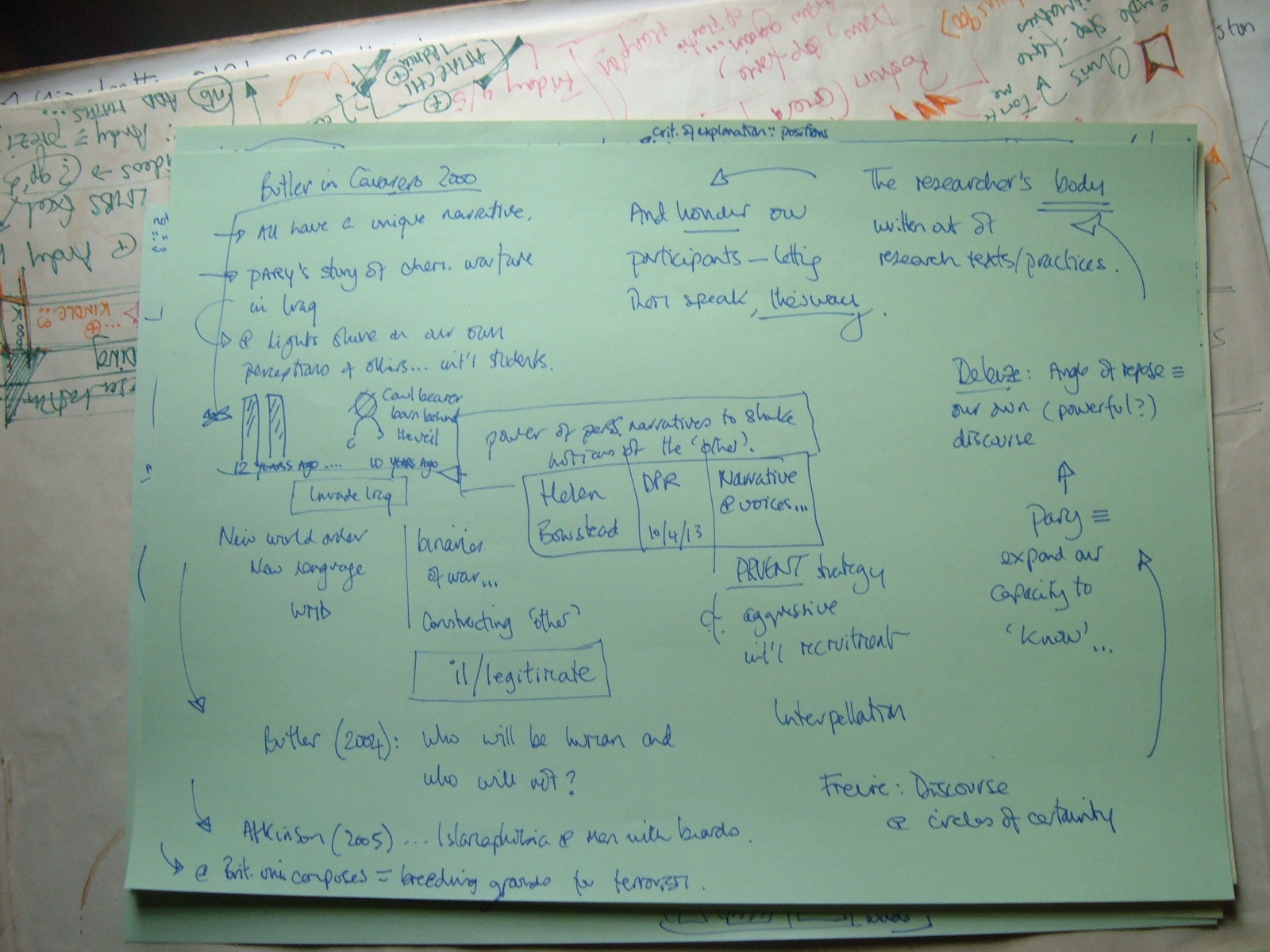
Helen Bowstead, also from Plymouth, discussed ‘the power of personal narratives to shake notions of the ‘other’’.

Drawing on Butler (2000) and Deleuze and her own excellent work on the power of ‘transgressive narratives’ within HE teaching and research, Helen spoke poetically of ways of working with and understanding our students, including our international students, that enriched all our understandings. She extended this to the research context illustrating how her approach can bring both the researcher and the participant more ethically into the research process. The power of this session was in the poetic extracts that Helen read out – which I do not have – so if this intrigues at all – do search for Helen Bowstead’s ‘writing’ work.


Sandra Birkett from Ontario gave a breathtakingly fast and engaging presentation on her work with teenage students: ‘Critical thinking in and on assessments’

Sandra de-constructed and elaborated upon staff expectations of students when they use terms like, ‘You will be awarded marks for:
  • Knowledge and understanding
  • Thinking and enquiry
  • Communication
  • Application.’
These taken for granted terms – by staff – have no meaning for most students – even more so in a digital era of super-fast responses, bite-sized learning, multi-tasking and instant-answering. This was no process of dumbing-down but of explication and de-mystifcation that really did seem to empower students to understand what was expected of them. I would like to get the PPT of this session to show to my own University students …


Julian Ingle of QMUL, and previously of London Met, explored ‘Writing as exclusionary practice…’

I heard rumblings amongst the younger participants as Julien argued against the privileged position of writing in the University assessment landscape. Writing tasks are proliferating with ancillary writing tasks sprouting like weeds and reinforcing prejudice against those, including those with various SpLDs, who find writing difficult. Julien suggested mildly that all students are offered more choice as to the way they would like to be assessed and asked us to consider how we might challenge the pre-eminence of writing and what alternative assessments might look like.


Almost in response to Julien, Zotzman and Hernandez-Zamora from Mexico argued for ‘Digital literacy as a tool for self-authoring…’

Perhaps unsurprisingly the Mexican public university system is as divided as the UK one with private universities well-resourced and heavily fenced – whilst the public sector is under-funded and attended by w/class students regulated and controlled by exclusionary practices such that even if they do produce a final dissertation – their voices will never have been heard and will not be visible in their own work. The re-authoring and re-genring work that Z and H-Z undertook with their students drew on Bakhtin (1981), Kress and Van Leeuwen (2001) and Kress (2010)  - arguing that words are only our own when we populate them with our own weight and that the affordances of multimodality offers agency, voice and expression… Examples included producing illustrated A-Z after Dahl and seemed to have empowering and transformative effect. This is another PPT that I would like to get so that I could under-take such work with my own students.


A powerful dialogic reply came from Choi who argued for ‘Using autobiography as pedagogy’

Choi encountered resistance when seeking Hong Kong w/class students to write autobiographically of their educational experiences. The power of this session, as with Bowstead’s, came from the poetic power of the student voices. Heartbreaking to hear the implicit internalised self-loathing of: ‘I got no cultural capital from my parents’. These bleak and desolate, to me, autobiographical extracts illustrated again the symbolic violence enacted on more communal and collective social groups when engaging in neo-liberal, individualistic education systems.


Simon Bell from Coventry School of Art and Design shared his PhD research work: ‘short odds = safe bet: go on, you know it makes sense’

Bell devised a range of creative, very short writing tasks for his students – the 300 word essay, the 120 word short story, the eight line detailed argument… An analysis of the student writing revealed the potential of these short writing tasks to engage and challenge the writer – to provoke and produce inspired and inspiring writing – and to reveal the potency of academic and professional literacies to even foundation students. We participated in group writing as part of the workshop – struggling to produce sixty words to answer an essay question on the positive nature of luxury – the other table were arguing for the luxury of freedom. It was truly engaging and stimulating to draft and re-draft – to really shape and craft – an answer in so few words. Again, I have discovered an emancipatory practice – I have never seen an activity deliver so well on the intended promise.


Our session followed Bell and concluded the Conference. We argued for the virtual as a ‘third space’ with emancipatory potential for teaching and learning. Bell and our sessions complemented each other – and we hope to work with Bell in some way as an outcome of the Conference.

Burns, Sinfield, Holley and O’Reilly: ‘Third Space – the final frontier? Disrupting learning landscapes, renegotiating pedagogic spaces’

Our proposal was predicated upon our belief that Education is in transition - commodity driven, marketised, rationed and controlled in ways that we have arguably not seen since the days when only the ‘top’ seven per cent went to University.  And wondered how can we be challenging, creative and yet more inclusive in these ‘interesting’ times. Winnicott (1971) argued that play is important in counteracting the implicit threat that occurs when we are in transitional spaces – between worlds, between social classes and in alien educational settings.  We wanted to see if we could playfully:
  • Disrupt concepts of educational spaces -  and use space differently
  • Devise authentic assignments and engaging pedagogy
  • Promote students as actors and agents
  • Occupy, name and yet liberate new pedagogic and virtual spaces?
We created alternative educational spaces in Second Life, a 3D immersive world (www.secondlife.com), to see if students inhabited these disrupted spaces in more powerful ways than the traditional lecture hall or seminar room. Our educational landscape became a seashore with sussurating sea, deck chairs, bonfires and puzzle cubes. We found that our students appeared as Bee or Klingon as well as ‘Barbie on the Poop Deck’ – and argued that disrupted pedagogic space can allow for more powerful student agency… Our more recent work (elaborated upon in the blog post below) argues for creative pedagogy and assignments – including the design and production of digital artefacts as alternative, empowering assignments.

I found this DPR really engaging, exciting and inspiring – I left with memories of creative and stimulating people and practices – with so many new things to do and try out and – hopefully – with a few more people out there with whom I might collaborate and cooperate in the future.

Wednesday, 3 April 2013

#edcmooc & #aldcon: creative teaching, learning and assessment

For a long time we have been advocating creative approaches to teaching, learning and assessment. We have built active and creative learning strategies into our teaching – and share those with other members of staff as part of our CPD work in the University. The #edcmooc has been the final piece of the jigsaw showing how to really scaffold the production of teaching and learning resources or digital artefacts – and #aldcon was where we showcased the work.

Teaching, learning… and assessment
In practice, developing creative approaches has meant advocating the teaching of visual, key word notemaking and scaffolding reading for students in ways that foreground the active and interactive nature of reading and the ‘point’ of the task.

We teach drawing and writing as thinking and exploratory processes and encourage students to keep visually stimulating and useful learning journals. At every stage we  emphasise the ‘what, why and how’ of activities – for if people can understand these – they can decide for themselves what to do and how.

In the last few years we have been setting as an assessment the production of a teaching and learning resource as an alternative to a traditional essay – though we still offer the essay as an option for those who can express themselves well in this academic form. We like to set the artefact option for those who either do not particularly enjoy essays or who want to stretch themselves in other ways. We feel that at this moment the teaching and learning resource option allows for more creativity and originality.

The essay is a long-established academic assessment engine with a heavy load of expectations and assumptions. Whilst we know that students gain more marks when they successfully take risks – taking risks with form and style in the essay is generally a mistake! However, if we as staff can let go of some of our assumptions and expectations, we can allow students to take risks in the design of a resource – and this can stimulate their engagement and pleasure in an assignment.

The design of an artefact can involve more than regurgitating what students have learned – it can be a thoughtful condensation of what they see as the key aspects of a course or part of a course and a multimodal expression of how to get others to engage with the ideas.

Of course as the whole of teaching becomes more digitally literate this sort of work will be introduced in primary schools and the academy will colonise and corral it. However, at this moment and at this time – this has not yet happened. So this is an exciting time to be introducing this new form of assessment (and I am loving it).

#aldcon: A creative approach to producing empowered students
With colleagues Tom Burns and Chris O’Reilly, we brought this to the Association of Learning Development Conference, Plymouth, March 2013. In our presentation we explored our take on a creative approach to teaching, learning and assessment. This included a creative way for academic staff and learning technologists to work together in ways that allowed everybody to bring their whole person and all their expertise to the table – rather than, say, for the academics to assume all the pedagogic and curriculum expertise and to ‘use’ the ‘technologist’ to ‘only’ contribute the ‘e’ bit of the equation.

In our case, Tom Burns and I as Education and Learning Developers worked with Chris O’Reilly as the Information and Systems Services person as a Team. As resources get more and more constrained, it has never been more necessary to stress the real value of all the people in a University who contribute to the students’ learning experiences and to the richness of their learning journeys. We wanted people to see the complex nature of the work that we had undertaken together – and how this had happened over time – and that it worked both within and outwith the curriculum.


Picture 1: The Team: Sandra, Chris and Tom.

Over the last two years we have worked together to build resources, to shape new modules and to develop interactive workshops to support staff and students.

Specifically, we have:

* Built our ‘metaphor maker’, the AniMet Challenge – as an OER online resource designed to support students in the research and development of learning strategies and resources:


Picture 2: ‘Blind drawing’ of the AniMet Challenge website. NB: We use blind drawing to show that *everyone* really can draw something!

* Built and extended our Study Hub – our student-facing website that has resources and activities designed to stimulate student thinking about studying – and that this year we have started populating with student voices about approaches to study:
Picture 3: The Study Hub


* Produced our ‘New to Uni’ video to showcase student experiences of those first few weeks – and to link to the Study Hub. Scroll down to see video:


* Produced a 30-week, 30-credit first year module, Becoming an Educationalist’, that actively teaches creative and emancipatory practice, that uses this to seed real student research in to study strategies – and that supports students in the building of digital artefacts informed by their own research.


Picture 4: Becoming an Educationalist (blind drawing of my nephew – shh – don’t tell him – he looks nothing like this – but he is a student on that programme).


* Produced a complementary 15-week, 15-credit second year module: Peer Mentoring in Practice – whose students mentored the first year ‘Becoming’ students – and who received a shadow creative curriculum alongside their mentoring training such that they could reinforce creative practices if they chose with the first year students.


Picture 5: Peer Mentoring in Practice

* Encouraged those first and second year students to be videoed for the Study Hub – so that their voices were heard in the University and that they did start to feel that they were in partnership with us in this meaningful project. Check out ‘Studying at University: http://learning.londonmet.ac.uk/epacks/studyhub/studying.html

* Developed Digital Artefacts workshops showcasing the ‘Creativity’ animation that Chris made and #edcmooc artefacts to reveal to students many different ways of producing their own artefacts.  Specifically, Chris made this:
http://www.youtube.com/watch?v=phn9I40fWxg&feature=youtu.be

And recommends this:

And now we’ve done these:

* The Artefacts workshops as well as building on Chris’ excellent work - are all supported by active reflection on – and using – the digital artefacts produced on the #edcmooc – and I really cannot think of a better way of preparing myself to support his new phase in my own teaching development. As I said in the blog post below (which also links to some really useful online resources with which to make digital artefacts):

The Conference Workshop
At the conference we discussed how we worked together – and what we think that we have achieved and why we did what we did… We pre-saged the final the activity by asking people at the beginning to make creative, visual, dialogic and heteroglossic notes upon the following:
What is creativity in teaching, learning and assessment?
What are the benefits of …
What are the potential risks…
What next?


Picture 6: #aldcon: workshop participants drawing their reflections.

For the activity, we asked people in their groups to use their visual notes and collectively draw their answers to any or all of the questions. We then filmed participants drawing their thoughts on the whiteboard – and recorded the participant’s commentary.


Picture 7: Drawing on the board – Chris filming – the story begins.

The film itself will be speeded up – and the voiceover put upon the final version. As I write this, Chris is still editing the films – and very soon we should be able to add them in the Comments below.

By jove – we’ve got it!
Hopefully everybody can see just how do-able is the making of a digital artefact. I hope it also demonstrates how at this moment if at no other, just how engaging and creative this process can be.


Picture 7: Connecting the pictures – telling a story


Picture 8: It all gets very dialogic and heteroglossic


Picture 9: Plusses and minuses of creative approaches


Here’s some #edcmooc stuff reprised 
Here is my artefact:
And a short one Andy made in GoAnimate of some of my text:
http://www.youtube.com/watch?v=dfx1_fVZbyI

And here are some cool examples from my classmates:
With apologies to all the other brilliant ones out there that I have not seen – or that I did see and forgot to copy and paste here…
Two-minute video: Log In: http://www.youtube.com/watch?v=-akQl-e1Awk
Angela’s Thinglink:
Fran Monaghan’s VoiceThread:
And June B’s blog plus vimeo artefact: http://www.jubo.co.uk/blog/2013/02/edcmooc-digital-artefact/  
And Ess Garland’s timeline: 
Theo Kuechel’s PinBoard:
The University Bog’s post and artefact:
Cathleen Nardi’s, Change your thoughts:
Amy’s Digital Life artefacts:

And finally…
If you have been engaged or intrigued or interested by any of these topics – please leave a comment with your contact details – or email us at London Met – and we are more than happy to discuss our work and share our resources with you – and even more delighted if you wish to discuss your approach and share your resources with us.

And do check out #aldcon for posts on the Conference – and the ALDinHE website – for the Conference resource will be available from there very soon.